Hawaii has strict Covid 19 regulations. Educate yourself before planning a trip. Learn more here.
Since international travel is out of the question at the moment, we have been working on a plan to continue our Grand Adventure without leaving the USA. Hawaii of course was at the top of our list and when they began welcoming guests again on October 15th, we were on one of the first planes to land that day. Maui now – open for business.
View from my lanai
To Travel or Not to Travel
I can’t answer this question for anyone but myself. Nor should you judge me for my personal decisions. We, as highly skilled and practiced world travelers don’t take travel or the virus lightly. We have spent a lot of time considering what and how our future will look and how travel will continue to be a part of it.
Quiet beaches in Kapalua
Maui, and other places like it, where you can spend 16 or more hours a day outdoors, and easily social distance even if dining in a restaurant, is the kind of destination we are looking for. And since we have been to Maui so many times, it was easy for us to plan and execute a five week visit to a place we know well.
Maui Now – Open for Business
It’s like someone flipped a switch. The lights are on and Maui is back in business.
We arrived on October 15th to our 86 unit condo to find only two other units occupied. The first few days or even weeks it was so quiet. Beaches were empty, resorts were closed, very few stores and restaurants were open. Four weeks later, more than half of the 86 units are occupied. Nearly all the resorts are open. This week marked the opening of several major restaurants and attractions. In the coming weeks even more attractions will come back on line as Maui prepares for holiday crowds. Maui Now – Open for Business.
Shops at Wailea working to reopen
Lahaina and other shopping areas are starting to reopen with more than half the stores restocking and welcoming visitors. All the stores are being very diligent about staff and visitors wearing masks – a mask law is in effect throughout Maui County.
Old Town Lahaina was hard it by the closure
But not everything survived the seven month closure. Like many places around the USA, restaurants and shops have closed permanently. It was just too much.
Social Distancing Easy
Hiking with my hubby
Is it safe? For me, I probably wouldn’t choose to go to a luau, but I have felt very safe at the handful of restaurants (all locally owned) that we have visited and sat outside. I have felt very safe getting take-out too. Again, for me I probably would not choose to do a group snorkel tour, although they are in full-swing. But I feel safe golfing with my husband, hiking on nearly deserted trails, and running every morning in my neighborhood. I feel safe at the beach where it’s easy to distance. We actually have avoided the collective BBQ at our condo, only using it twice in a month, in an effort to not stand around with other people we don’t know. We usually have the pool to ourselves when we go there, as most people go to the beach instead.
One of the few restaurants we have been to, Sam Sato
Gathering with Friends
Strolling in Lahaina with our friends Steve and Dori
Completely unplanned but fun nonetheless, we happened to be here at the same time as several friends from back home. I have felt safe spending time with them in small groups. Each of them had to be tested before arriving, and each of them are practicing the same safe distancing and mask wearing rules we are. So we socialized with a hand full of dear friends and it made our visit all the more special.
A Real Vacation and Taking a Break
Chilling
Being here for a month (with one more week to go) has felt like a real vacation for me. More relaxing than many of the places we travel. Taking a social media break was a wonderful cleanse and I really needed that. I’m so glad I was able to plan and schedule many blogs and book reviews before leaving home – leaving me time to just be present here in Maui.
Little discoveries on my daily run
We have spent a lot of time in the sun, although I have made a conscious effort to be more careful with my tanning (hard for me as my skin is a sun sponge). We have been just active enough and just lazy enough and just social enough and just the two of us enough to make it exactly right. Just enough as we head back to rain and dark and upcoming stress back home – where the Covid numbers are surging.
Where Do We Go From Here
Blow hole at Kapalua
We continue to work hard to stay healthy but of course who knows what the future holds. If Covid has taught me anything it’s that I am not in control. In fact I just read a line in a book that I loved – “If you want to make God laugh, tell him your plans.” That’s a quote from Anxious People by Fredrick Bachman. And ain’t that the truth. Making plans you have no idea if you can keep is the new way of life in the time of Covid.
Maui morning
So we head home November 20th and prepare to be with our family for the holidays, deal with some medical issues and prepare the house and ourselves once again for a departure. Mid January we head to Palm Desert where we plan to spend two months, Arizona for another month and Utah for a few weeks after that before heading back to Washington State in May.
These are our plans…hahahaha.
The Grand Adventure, a bit of a kink in the road, but it goes on.
We love it when you pin and share our blog. Aloha.
Here we are. Day ten already, Maui Musings on Island Time. So blessed to be here and feel safe and healthy here. Realizing now how hard hit this place is economically. I’m glad we didn’t cancel and can contribute in a little way to bringing it back to life. Here is our story, day ten.
Getting Here Wasn’t Easy
We came so close to canceling so many times. We didn’t want to lose any more travel money, and we had made these reservations so long ago…back in the days of carefree travel and no pandemics.
Our view
Neither myself or my husband had received our negative test by the time we boarded the plane. On arrival my negative test was in my inbox. Arne was still waiting. In fact he would wait another 12 hours until it arrived. So Hawaii told him to go into quarantine and stay put. When his tests arrived he immediately uploaded it to the Hawaii website per all the instructions but it would be another 36 hours before he received his official release from quarantine. My advice would be NOT to come unless you can get the rapid test because the red tape seems to be taking a long time. We talked to a woman today who has been waiting four days…and she is ignoring quarantine.
By the way when Arne received the email that he was free to leave quarantine we ran down the stairs and jumped in the ocean. A perfect celebration.
Where We Are
We call it the Lund Condo, owned by Arne’s uncle, at the Kihei Surfside, as far south as you can go in Kihei at the Wailea entrance. We have been here many times over the past 23 years. It’s a remarkable place and we are blessed to have access to it. The view is unsurpassed. In fact the unit had some major work done to it last February, and then everything shut down. So we are the first guests to enjoy all the new and beautiful tile work.
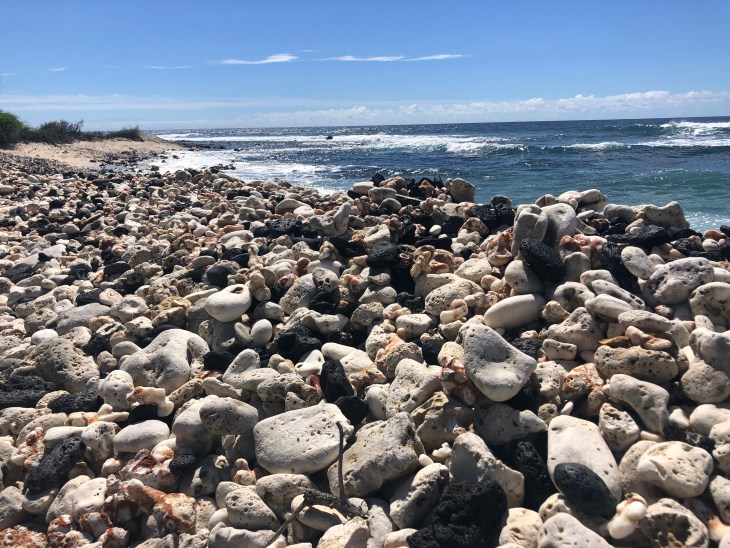
Maui rocks
Since we have been here so many times, we know the area well and it feels like home turf. We are very sad to see one of our favorite restaurants next door has permanently closed. I know there are more too that didn’t survive the shut down.
Even though we have been here many times, we have never stayed as long as we will stay this time. It will really feel like home by the time we say Aloha in late November.
What’s Open What’s Not
Since we were one of the very first visitors to arrive on opening day, the first two days the island was so quiet. Our condo which has 85 units only had one other occupied unit. The beach was empty.
Pool to ourselves
Ten days later the condo now has about a dozen occupied units but the beach and pool are still lightly populated. When walking around most people are wearing a mask, but not at the beach where it is very easy to distance. Everyone is masked up inside the stores. But if I’m being honest here, visitors are more resolute with mask wearing than locals…so far.
Empty beach
The large and fancy resorts near us in Wailea are all closed, with opening dates in early November. There is a beehive of activity at these resorts as the staff prepares the grounds and insides for guests. There have been no guests since March.
Grand Wailea Resort still closed
Small restaurants are open, but most of the large restaurants are still closed. The famous Mama’s Fish House is scheduled to open November 6th. Old Lahaina Luau is scheduled to open November 20th. Today for the first time we saw some snorkel tours heading out from the harbor next to our condo. Slowly, slowly things will come back to life.
Our Approach
We have not been to any restaurants. We went to the grocery store on our first day and stocked up and went again today on day ten. We have been cooking and eating clean and healthy and delicious.
Golfing
We have been running and doing yoga on our own each day…very easy to distance. In the past I have taken yoga classes here but this time I will continue my own practice to be safe and solo.
Hiking
We took a hike where we saw only three other people. We went golfing and it was easy to distance. So far, we have just done a lot of things quiet and easy. Beach time, pool too. All distanced. Feeling safe and healthy. In fact, it’s really not any different than home…well except the weather. That’s a lot different.
Eating healthy at home – Taco Salad
Socializing
We have several friends on the island, some from back home and some who are here permanently. We plan to get together with them, in pairs so to keep it easy to distance. We hope to invite several couples over to watch the sunset with us here at the Kihei Surfside. It’s a great place and makes a perfect evening with friends…distanced of course.
Social Media Purge
Over the past ten days I have had great success staying off social media…it’s actually easier than I thought it would be. I’ve checked in a couple of times, but not every five minutes per usual, and it feels good to just take a break. My blog posts will continue to post automatically and I will check in from time to time.
The Mug
Meanwhile, time for a gin and tonic I think. A little Aloha and down time is just what the doctor ordered. Maui Musings, on island time. Wish you were here….
Inspired to explore environs closer to home, meaning in the United States, we set out on a road trip in August. Road tripping Idaho USA began in Washington State. We traveled 3375 miles through 5 states over 13 days. Our goal was only to sate a wee bit of our wanderlust and see a few towns and regions we had never visited. This is the first installment of three part series of our road trip adventures.
Hiking was at the top of our list for our road trip activities
Road Warriors
I should start by telling those of you who don’t know, that we have visited all fifty states. Yes, in addition to the 110 countries we have visited we can also claim to have visited all fifty states. Admittedly I am a bit of an overachiever (insert eye roll).
But point of clarification – the way we accomplished this momentous task is by…wait for it…ROAD TRIPPING! Yep, it’s really the only way to visit all 50 states, and over the past twenty-eight years we have traversed the entire country on six separate road trips. Our first road trip was in 1992 when we drove from Washington State to Washington DC. So our Road tripping Idaho USA begins our sixth USA road trip.
Rural Idaho offers a lot of wildlife viewing opportunities
Road Tripping in the Time of The “C” Word
That inconvenient virus has made every aspect of our lives a struggle, including a summer road trip. We planned a socially distanced itinerary and were able to pull it off by planning ahead, traveling with cleaning supplies and wearing our masks. We spent multiple days in Idaho, Colorado and Oregon.
Way to go Idaho
Given that Idaho is the neighbor to my home state of Washington you’d think I would have spent more time there. But not so much. I’ve visited the panhandle multiple times, and the city of Boise, but on this trip I really wanted to see more of the mountains in the south so that’s what we set out to do.
Beautiful Twin Lakes, a four mile easy round trip hike in McCall
We drove our first day to Spokane, still in Washington State but right on the border with Idaho. We spent a fun evening with my husband’s brother and his wife, before making an early morning escape under the cover of darkness. Today’s drive was about six hours to McCall Idaho (crossing into Mountain time zone), home to Payette Lake, Brundage Mountain and beautiful scenery.
We spent our first day in McCall enjoying the company of dear old friends who have retired to this gorgeous area. It’s not hard to see why they would choose it. Everything you might want is here; hot dry summers, cold dry winters, hiking, biking, boating, skiing, great dining and beer. Wow.
Abundant wildflowers at Twin Lakes
Day two in McCall we did two easy hikes. First we hiked to Twin Lakes, an easy four mile round trip suitable for just about anyone. It was one of the most peaceful places I have ever been. We had gotten an early start and found the trail and the lake deserted, except for a lone fisherman…perfect. The views were like a postcard…actually better!
Next we went to the Brundage Ski Area very popular in the summer for mountain bikers. We had a delicious lunch (socially distanced outdoors) on the deck of the lodge before riding the chair lift ($15) up to the top of the mountain. Here we could see all the way back to McCall and Payette Lake and well beyond. The chair lift ticket includes a round trip, but we hiked the 4 mile cat track back down to the lodge, enjoying a wide variety of wildflowers and bird life, and only a handful of other people.
Masked up for the chairlift ride at Brundage Ski Area
We spent our two nights in McCall in a tiny little cabin a block from the lake. Teeny kitchen and bath, a comfy bed and a fireplace make this place cozy and perfect for a few days winter or summer. We also enjoyed sitting around the campfire in the evening. See it here.
Payette Lake is a dream for boating and water sports
Day four we exited early, heading south to the famous Sun Valley region. We had never visited Sun Valley and it had been on my list for a long time. Sun Valley is made up of several towns, and several ski areas. The best known town is Ketchum. We stayed in Hailey, about five miles outside of Ketchum (another peaceful and exceptionally well kept Airbnb. See it here).
You can see forever from the top of Sun Valley Ski Resort
Our first day in the valley we took the gondola at Sun Valley Ski Resort up to the top of the mountain ($25). The weather was clear and warm and you could see for a hundred miles. We had an outdoor socially distanced meal at Warfield Distillery in Ketchum and explored some of the local microbrews.
A great view from the outdoor patio at Warfield Distillery in Ketchum
Day two in the valley I enjoyed a long morning run on the Wood River trail that runs for 15+ miles all along the valley. Next we took a short hike on a nature trail near our Airbnb along the Wood River. We finished our day playing nine holes of golf at the beautiful Elk Horn Golf Course. Sun Valley is peppered with golf courses…wish we had been able to check out a few more – next time!
A beautiful golf course, Elk Horn in Sun Valley
Feeling Safe in Idaho
Idaho has a population of 1.75 million and ranks 35th in the USA for virus infections with just over 28,000 (Source Statista as of August 19th). In both McCall and the Sun Valley area we found people wearing masks in all stores and restaurants and many people wearing masks on the sidewalks in town. Idaho was dead last in the USA for cases until mid-June when virus cases began to rise.
Mountains Majesty – the Sawtooth Mountains
We made a point to keep distanced, choose activities where we could easily stay away from crowds, and we enjoyed our road trip in Idaho. It really is an underrated gem in the United States. Now I want to go back in the winter. Road tripping Idaho USA filled our goals.
Join us next week for our Colorado installment of Road Tripping USA.
I grew up in the Pacific Northwest in the 1960’s and 70’s. Back in the day, salmon was cheap, local, abundant and taken for granted. Today, salmon is not as abundant in the waters of the Puget Sound. In fact, growing up with fresh salmon, oysters, clams, Dungeness crab and many other stars of the sea right in my backyard, I know now, we took it all for granted. This is how I have falling in love with wild caught Alaska salmon.
Fast forward forty years and as I travel around the world in my nomad life (currently on pause due to that inconvenient little virus), from Malaysia to Spain, I’ve run across some truly remarkable, unique and delicious fish I was never familiar with before. And I’ve also learned that most people around the world are eating farm raised salmon…that disgusting excuse of a fish. It’s why I never order salmon in a restaurant anymore unless it says wild caught Alaska salmon.
It’s like Christmas in July!
Back home in Washington State I don’t buy fish in my grocery store much either, because it is either Atlantic farm raised or thawed from previously frozen – and I’m unclear of how long ago that might have been. Did you know approximately 91% of the seafood that the United States consumes is imported from overseas? A significant portion of that fish is un-sustainably farmed. It is harmful to the environment and unhealthy for humans. Gross.
There used to be a woman in my hometown of Gig Harbor who had a small business selling wild Alaska salmon her husband caught in the summer. But she is no longer operating which led me to go searching for other options.
What a great story this company has. A family run, sustainably fished, environmentally conscious business with an amazing product you can have delivered right to your door. What you say? No joke. And, the customer service is remarkable.
So much yummy goodness in my box
I’ve been a member now for two months and we are eating so healthy having this beautiful fish in my freezer. Wild Alaskan offers monthly membership (cancel anytime), with door to door delivery of your choice of a box of salmon, or white fish, or mixed. I am currently enjoying the mixed which includes coho, sockeye, cod and halibut. I did a special order too of sable fish (often called Black Cod). Wild Alaskan salmon is always frozen soon after it’s caught to lock in that fresh taste. You want it frozen – that’s what makes it taste fresh. Seems weird but it works.
Wild Alaskan has given me an affiliate relationship, which means at no additional cost to you, I will earn a commission if you click through and join the fish club. AND if you use this link you will get $15 off your first order! So please check out the recipes I am providing to you below and place your order for your first box, and get cooking and enjoying unique and sustainable wild caught Alaskan fish – the best in all the world.
Watch for a blog in a couple weeks all about recipes for white fish. Meanwhile enjoy these;
Simply Salmon
Simply Salmon ready for the BBQ
Simply Salmon on top of a delicious salad
Frankly when the fish is this fresh, it really doesn’t need much done to it, and that is why Simply Salmon is one of my favorite preparations, especially in the summer. Easy and delicious
Serves Two
Two 6 oz Fillets Wild Alaskan Salmon thawed and placed on foil
Smear one teaspoon of butter on each
Squeeze juice of one lemon over all
Salt and pepper to taste.
Wrap salmon up in the foil leaving a vent at the top and place on hot BBQ for about five – seven minutes, test it for doneness it may need a few more minutes but be sure not to overcook.
Enjoy.
Smothered Salmon
Smothered salmon going into the oven
Smothered salmon over a bed of barley salad with warm vinegaret
This recipe works both for the BBQ or the oven and we have served this both summer and winter.
Serves Two
Two 6 oz fillets Wild Alaskan Salmon thawed
Place salmon skin side down on a foil covered cookie sheet if using the oven, or on a large enough piece of foil to put on the BBQ
In a separate bowl mix two tablespoons of mayonnaise, 1 tablespoon of coarse ground dijon mustard and 2 tablespoons of grated parmesan cheese
Smear each piece of salmon with mixture and bake at 350 degrees or BBQ until done.
Squeeze of lemon before serving
Salmon Lox
Salmon Lox with weights ready to go in the fridge
My favorite breakfast, lox and bagles with fresh made lox
One of my favorite breakfasts in the world is lox and bagels with cream cheese, until recently when I learned that much of the lox I have been eating is farm raised. So I made up this recipe for my own.
Two 6 oz fillets Wild Alaskan Salmon thawed
Set the salmon on your cutting board and let air-dry for about 20 minutes. Then pour one teaspoon of good gin over each fillet. Let sit for another ten minutes.
Meanwhile in small bowl mix 1.5 tablespoons sugar
1 tablespoon kosher salt
1-2 teaspoons fresh ground pepper, preferably a mix of black, white and red peppercorns (I use my mortar and pestle for this)
1/3 cup fresh chopped dill fronds
Place one salmon fillet skin side down on large piece of cellophane. Top with sugar mixture. Place second piece of salmon on top of it – skin side up – to make a salmon sandwich. Wrap tightly in cellophane, use another piece of cellophane if necessary to seal it.
Place the salmon in a shallow dish such as a pie plate then top with another dish big enough to hold several cans of beans or tomatoes or whatever you have. These will serve as a weight. Place in the refrigerator for 3-4 days, turning once or twice a day and draining the liquid that collects in the dish.
Slice then and Eat!
Salmon Pie
Beautiful and cheesy salmon pie
Salmon Pie is delicious both hot or cold
Well, having salmon leftovers is really unusual, but if you find yourself in such a situation, this is an old family recipe from my husband’s side of the family. It was one of my kid’s favorite things when they were growing up.
Serves Four
In the bottom of a deep dish nine inch pie shell layer one cup of cheddar cheese. Take about 2 cups of cooked salmon broken into pieces and toss with 1 tablespoon of flour. Layer the mixture on top of the cheddar cheese.
Chop one bunch of green onions including tops and sauté in two tablespoons of butter. To this mixture and on medium heat add one can cream of mushroom or cream of celery soup, 3/4 cup sour cream, 1 teaspoon dry dill and 1/8 teaspoon white pepper. Cook until combined and bubbly. Remove from heat and stir in two eggs. Pour mixture over the top of the salmon and cheese in the pie shell. Place the pie on a cookie sheet then bake for 30 min in a 325 degree oven. Let sit for 10 minutes before serving. Good both hot or cold.
Smoked Salmon
As part of my weekly TASTY TUESDAY on YouTube, our final recipe is a video, with instructions on how simple and delicious it can be to smoke your own Alaska salmon. You only need salmon, water, salt and brown sugar to create a delicious smoked salmon.
And there you go – my top five salmon preparations, each one made better with wild caught Alaska salmon. I’d love to hear from you if you try any of these recipes! And watch for more great fish recipes coming your way soon.
Witty and wonderful, this easy to read memoir, Kalb’s first, is a perfect read for these days we are living in.
Kalb (who is an Emmy-nominated writer on the Jimmy Kimmel show) saved every voice mail her grandmother Bobby ever left her. And with these little gems and a few zingers, Kalb crafts a delightful story of growing up with Grandma Bobby.
Told in Bobby’s voice after her passing at age 90, we follow four generations of women. Bobby’s mother who immigrated from Belarus in 1880, Bobby’s rebellious daughter in New York City in the 70’s and finally Bess, Bobby’s grandaughter in modern day Los Angeles. Each of these women and their ties to Bobby make up this beautifully told true story.
If everyone grew up having a grandmother like Bobby, everyone would be successful and happy. What a character she was and she loved so fiercely.
I enjoyed Kalb’s writing style and the character development was excellent. I found it particularly poignant the huge leaps each generation made leaving a huge chasm between Bobby’s mother and Bobby’s grandaughter. I think we often forget what our ancestors endured so that we could live so abundantly.
*****Five stars for Nobody Will Tell You This But Me by Bess Kalb
Just under four years of nearly non-stop travel, as well as many adventures earlier in my life, has left me with an unbelievable collection of epic adventures around the world memories. Lucky me.
I’m not giving up on resuming our travel life…however I expect we will sit home for a year before we set out on anything too epic. And even if that never happens, what a life we have led.
In my living room I have a large book case that I call “The Museum”. Here I display my world treasures. There are not alot, given the fact that we travel light and I try not to do too much shopping as we travel, but I rarely leave any country without picking up something special. I love looking at “The Museum” and although I appreciate when guests look too, “The Museum” is really for me, a reminder of my blessed and adventurous life.
The Museum
As I wait to determine what my next chapter in my life is going to look like, I spend a lot of my brain cells reliving some of my life’s greatest epic adventures. Therefore it seemed like a perfect blog to pull together and share. My Epic Adventures Around the World. I hope you enjoy.
The Inca Trail and Machu Pichu – I don’t have a blog about this experience, it was before I began blogging about my travels. But it was a defining experience in my life, opening my eyes to my own physical capabilities. The five day hike on the Inca trail to Machu Pichu took every thing my body had to give, while also providing some of my all -time favorite zen moments. Life changing.
Galapagos Islands – Everything about the Galapagos Islands is unique and memorable – both on land and in the sea. One of our favorite trips of all time. The day we snorkeled in the Galapagos was the only time I have ever swam with seals who danced a playful ballet around us as we swam. We also encountered baby seals, beautiful turtles and small sharks. Just one remarkable event in a very remarkable place.
Weekend with the Monks South Korea – spending the weekend at a Korean Buddhist monastery was a unique and slightly painful experience. Living as a monk, mostly in silence, sleeping on the concrete, up before the sun and hours of meditative prayer was certainly memorable. But my favorite part was meeting the female monks at this monastery, hearing their story and gaining such an admiration for such a devout life.
Easter Island Chile – Everything about Rapa Nui was stunning, but like most visitors I had my favorites. And like most visitors my two favorite sites were the Ranu Raraku quarry site and the Ahu Tongariki. Upon laying your eyes on these two sites for the first time you conjure a list of adjectives; breathtaking, fascinating, interesting, surprising, remarkable. At one point I had to just stop and breathe deep – and remind myself how remarkable it all was, and how remarkable it was that I was standing there.
Namibia – Arne and I both have Namibia on our top five list of one of the most beautiful countries and most incredible experiences ever. That is saying a lot in 110 countries. Unspoiled, incredibly diverse and still remarkably authentic, Namibia is astonishing. I have two excellent blogs about our experience there. The link above is the first one. Here is the second.
Sunny Namibia
Burkina Faso – who goes to Burkina Faso? Well apparently I do. I didn’t really want to go, but in hindsight spending three weeks there visiting our Peace Corps son was one of the most remarkable and eye-opening travel experiences of my life. And doing it with my grown sons made such fantastic family memories. I will never regret having gone.
Burkina Faso
Inle to Kalaw Hike Myanmar – I don’t have a blog about this experience, but it did win one of our 2019 Travel Awards for it’s uniqueness. This two day hike was longer and harder than I thought it would be (I should read the fine print) but the experience was amazing. Our guide was great, the food was surprisingly abundant and delicious and even sleeping on the floor in the home of a local Myanmar family with no electricity or running water was a memorable experience.
Camino de Santiago Spain – Hands down one of the best, most spiritual, most life affirming experiences of my life. Walking 500 miles across Spain – 40 days, thousands of memories, one incredible experience. I hold this memory very, very dear.
The Grand Adventure Spain
Gorilla Trek Uganda – a life-long dream for me to trek to see the elusive Mountain Gorilla, for me this has also become a marker for the Corona world-crisis. Doing this tour was the last “normal” thing we did, before the world spiraled out of control, and came to a screeching halt. I will be forever grateful that Covid-19 did not stop us from doing this experience, and I will remember these creatures fondly.
Tiki Tour in New Zealand– who knew living in 90 square feet could be so much fun? What a remarkable way to see one of my top favorite countries, New Zealand. I would do this again…and have also considered doing it in Australia. To really see all that is fabulous about New Zealand, a Tiki Tour is the way to go.
The Great Barrier Reef Australia – I had to really convince my husband that snorkeling in the Great Barrier Reef off of the east coast of Australia was worth the money. But I wasn’t visiting Australia without seeing the reef, and despite a crappy weather day, our experience in the ocean was amazing. A pinch me moment, in a life of pinch me moments.
Alps Hike Switzerland – with total honesty and without hyperbole, this day hiking the Schilthorn was one of the best days of my life. The physical challenge of it was astonishing, the beauty of it was heavenly and the satisfation on a travel scale of 1-10 was a million. Blessed day.
Camel Trek in Morocco – incredibly painful, incredibly memorable. Our overnight camel trek in the dessert of Morocco was quirky and special, despite how uncomfortable riding a camel can be…who knew? But I’m so glad we did it; overnighting in the Bedouin camp, drinking wine around the camp fire in the chilly dessert night air, then rising again and clamoring back onto the beast for the trek back. I’ll never forget it.
Sunny Morocco
Bangladesh– we would have never gone to Bangladesh, except our friend Natalie was teaching there…so why not? A quick stop in this untouristed country to see what we can see. Wow. I would never imagined that we would have enjoyed it so much and have one of the most authentic travel experiences of our life.
Beautiful Bangladesh
Above it all – we paid a ridiculous amount of money to have two separate experiences in our travels – both taking us high above it all. It’s always hard to know if these things are worth the money, especially when we travel on a fairly strict budget. But for me, both of these experiences were worth every penny. Climbing the Sydney Harbor Bridge in Sydney Australia and flying in a Hot Air Balloon over Bagan Myanmar. These both will go down in our travel life as phenomenal.
The Grand Adventure Australia
So the Grand Adventure is on sabbatical until further notice. I continue to hope we will travel again…but the brake is firmly set until further notice and we turn our attention to other inspiring adventures…stay tuned, and don’t give up.
Thank you for continuing to support our blog – we promise lots of interesting and inspiring articles coming your way. Be safe. Be healthy.
Do you remember the 1988 movie Gorillas in the Mist based on the life of Dian Fossey? The film takes us to Congo, Uganda and Rwanda where Fossey studied and tried to protect the magnificent mountain gorilla. She gave her life doing so. But to her credit there is no disputing that her work saved the mountain gorilla from extinction and opened the doors for gorilla tourism. Thanks to Fossey, I marked my 60th birthday on a exhilarating Uganda Gorilla Trek.
Juvenile mountain gorilla
Most of us have seen lowland gorillas in zoos. But the mountain gorilla has not been able to survive in captivity. Biologists are not sure why they don’t survive. So the only way to see these animals is to go to them.
And so, for one blessed hour, I sat in the jungle of Uganda and observed up close and personal one of earth’s most noble, splendid and humanlike creatures.
Can be mean, but just playing here.
Expensive
Unfortunately doing a Uganda gorilla trek is expensive. The cost is mostly due to the permit fees required by the government. The money of course is helping continue to save these magnificent beasts, but at $600 per person for the permit alone, it’s beyond reach for many people. Rwanda’s permit is more than twice as much. You can trek in Congo for less, but you would also be putting you life in danger going to Congo. And so, for us, as a celebratory birthday event, we chose to do our Uganda Gorilla Trek with Achieve Global Safari of Uganda.
Two year hanging out
How it Works
Through Achieve you can sign up for three day, five day, ten day or however long you want. Achieve can take you beyond the Uganda Gorilla Trek and also show you many of the other wonderful animals and sights of Uganda. But having already done a couple of safaris, our focus was just the gorillas.
With our guide John
We arrived at Entebbe Uganda in the afternoon and were met by our guide John. We were so glad to have been assigned John, he turned out to be an amazing guide. John took us from Entebbe about an hour to our Marriott hotel in Kampala for a first night. Very nice hotel. Bright and early the next morning John picked us up for the ten hour drive from Kampala to Bwindi Impenetrable Forest National Park.
The Drive
It was a very long drive, but we saw some interesting sights along the way, including a stop to have our photo taken as we crossed the equator. This was our first time crossing the equator on land.
On the equator
We also enjoyed seeing many beautiful birds, zebras grazing alongside cows, and the famous Ankole longhorn cows praised for the beef and milk. We enjoyed seeing mile and miles of agriculture. Uganda’s mild climate and long days provide a stable growing environment year around for everything from sweet potatoes to bananas, onions to avocado, rice to pineapple. We passed dozens and dozens of villages large and small and slowly ascended into the mountains. At the highest point we were at 7800 feet (2400 meters) but came down to about 6500 feet on arrival at our lodge.
Ankole Cow
Ichumbi Gorilla Lodge
Verandah for our room in the jungle
If you decide to make this trek we highly recommend using Achieve, asking for John to be your guide, and requesting to stay at the beautiful Ichumbi Gorilla Lodge. Small, lovely, comfortable and possibly the best service of anywhere we have stayed in all of Africa. I wished we had the time to stay longer and linger…enjoying the misty mountain views and relaxing on the verandah. The food was also exceptional. A very nice touch was a hot water bottle placed in our bed every evening to keep us warm as the mountain temps dropped.
Hot water bottle for a good night’s sleep
Uganda Gorilla Trek Day
Overnight I woke up with a frightful headache, and I knew I was suffering from altitude sickness. At breakfast I began to feel very queasy and I was unable to eat anything. Damn. I was not going to miss this! I put on my happy face and we headed to the trek site.
Three year old
In 1981 it’s estimated there were only 250 mountain gorillas left in the world. Thanks to conservation efforts the population is healthy and growing in all three countries where they live. There are 36 gorilla families in Uganda’s Bwindi National Park, with a total of about 650 gorillas, half the world’s population. Of these about 13 families are currently habituated for the tourist trekkers. Habituation began in 1991 and the first trekkers came in 1993.
The time of our lives
After a briefing by the ranger and some local entertainment, we were split into groups of eight and assigned to trek to one of the families. The families stay within a general area that is their home, so using advance tracking ranger teams, the guides know approximately where the gorillas are hanging out today.
The eldest female of the family
Our trek group consisted of a German/Dutch family of four, two women from Estonia and me and my husband. Our lead ranger was Phillip and we were accompanied by two armed guards, one forward and one aft. In addition local porters could be hired ($15 US minimum) to assist trekkers with their packs or to help them through the mud. We were the only ones who hadn’t hired a porter and we probably should have, if only to provide a good day’s employment to a local person.
Mama Gorilla
Nshongi Family
Despite my upset stomach I was feeling pretty lucky when we were assigned to the Nshongi Family. This currently is the biggest habituated gorilla family in Uganda with 25 members but more than 10 have left to form another family called the Mishaya Group. The Nshongi group also was in a area we could hike to from the orientation site, instead of driving a distance to start the hike. I started to feel better once we started moving and after the first few kilometers I was no longer suffering the upset stomach. Instead I was focused on what was turning out to be a very difficult Uganda gorilla trek. (read more about all the habituated families here.)
The kids at play
Mud
Our name was mud. Wow. So much mud. It sucked at your shoes and oozed into your socks. It had rained a lot the day before, and we were counting our blessings for a clear morning, but the weather the previous day left its calling card and it was named mud. There was no chance of staying out of the mud and so we didn’t try. I was very glad to have my hiking poles with me as we trekked along, slurping through the muck.
Mud
It took us about two and half hours before our guide was on the radio conversing with the advance trackers. We were feeling lucky since we had heard that sometimes it takes 7-8 hours to find them. The trackers had the gorillas in sight. But the gorillas wait for no tourists and they were on the move. At this point we left what was somewhat of a trail and went headlong into the dense bush. Our guide Phillip had a machete and he hacked as much of a trail as possible for us as we stumbled through the vines and bushes and up the mountain side. The sweat was pouring off of me.
One of the females
And Then There They Were
My heart stopped as the first gorilla, a small juvenile, came bounding across the path right in front of me. But he was gone in a flash. We continued, hacking with the machete through the bush. Suddenly there were four gorillas, two females and two two-year olds. The kids were playing and the mamas were resting after their lunch. I was taking photos and switched to video just in time to have this little fella get up on a branch and pound his chest. Chest pounding in a large gorilla can mean an attack, but this little guy was just acting tough and I was smitten.
Baby playing
Our guide led us down a little incline into a clearing where two more juveniles (a three year old and a two year old) were wrestling. This is both a form of exercise and play, but also a way for the older gorilla to teach the baby. We were watching this playtime and our guide had me step a little to the right and pointed ahead about twenty yards. And there I saw him. A resplendent silverback gorilla.
The Silverback
King Kong comes to mind. This beautiful creature is twenty-four years old (they live as much as forty) and weighs nearly 500 lbs. We never saw this beast stand up but mountain gorillas can grow as tall as 2.25 metres (7.5 feet). The mature male sports a crest of fur on his head and the magnificent silver fur on his back.
Just chilling
Our new friend seemed quit content as he laid there snoozing, then grazing, then watching the littles play. Unlike many in the animal kingdom, the patriarch of the family is intricately involved in the lives of the young. The little gorillas crawled all over him, banged on him and cuddled up to him as he lay. He rolled over into a half sitting position (he seemed to be posing for a centerfold) and watched us watch him. He addressed the kids with a gorilla grunt, which sounds more like a pig grunting than what you think a gorilla would sound like.
Papa and little one
Slowly, slowly, my heart returned to it’s normal rhythm as our hour with the Uganda Mountain Gorillas came to an end. Phillip said it was time for us to take our final photos, as our hour was nearly up. As if he understood, the Silverback sat up, looked us in the eye and we snapped our final shots.
Farewell.
Watching us
Final Thoughts
On our trek back we had to ford a couple of high running streams. We were soaked, muddy and exhilarated. I don’t think anybody was thinking about how hard the trek had been…only thinking about how rewarding.
Once in a lifetime. I feel so grateful.
Wrestling for fun and learning
I should point out again that the hike was very difficult. Occasionally there are trekkers who just can’t go on. The porters provide another service, but for a price. An additional $300 USD and they will literally carry you in a kind of rickshaw up the mountain. They call this the gorilla helicopter.
Lunchtime
On our return ten-hour drive back to Entebbe for one final night before our flight out of Uganda, John took the time to really share his gratitude to us for choosing to visit Uganda. He elaborated on how many jobs are created through gorilla tourism – not just the guides, the rangers and the porters, but all the staff at hotels, restaurants, shops and gas stations. This on top of the money we invested into the conservation of the gorilla through the work done by the African Wildlife Foundation.
Silverback sleeping while toddler waits
Our five day tour included four nights lodging, all our meals, a personal vehicle and our guide John, park entrance permits and all the staff it took to get us up the mountain to the gorillas. We tipped everyone generously. Total for all of this was $3100.
What a day
We were sorry our visit to Uganda was so short. It’s such a green, friendly country with UNESCO recognizing it’s biodiversity. Certainly Uganda still has political challenges, and the Entebbe airport is in need of signifcant upgrades. But as a visitor, there are so many exciting options for wildlife viewing, Uganda is poised to be the next big safari destination, although currently still flying under the radar. Your dollars help both the people and the animals, and help save the habitat of these incredible creatures. Just like in Borneo when we visited the Orangutans, loss of habitat is the greatest threat.
If you can afford it I highly recommend a Uganda Gorilla Trek. Come now…before the secret gets out. Come for the gorillas. Come for the beauty. Come for the people of Uganda. Uganda, the Pearl of Africa.
We love it when you pin and share our blog. Thank you!
Two years ago we visited South Africa, spending nearly a month in and around Capetown and the Western Cape. But we didn’t get to Johannesburg.
At the time, I was afraid to visit Joburg, falling victim to the media accounts of a violent place. The very same media accounts I now try to convince would-be travelers to take with a grain of salt.
Artwork at Constitution Hill
Because Johannesburg, like countless places around the world, certainly has some areas you don’t want to wander around alone. It has violence, crime and continuing racial divide. But all that said, during our short visit we found a sparkling clean city with a beautiful airport, good infrastructure and roads, art and cultural sites and kind people.
Johannesburg’s violent past should be remembered and never repeated, all while this city of 8 million people (five million in Joburg and 3 million in Soweto) works with painstaking slowness towards a future where people of all races have the same opportunities.
My husband inside one of the tiny isolation cells at Prison #4
Trying to see Johannesburg South Africa in one day? Is it enough? No it is not. But one day was all I had and so we made the most of our time with a tour with MoAfrika. During our more than nine hours with MoAfrika and our tour guide Michael, I experienced a rollercoaster of emotions as I witnessed and learned about the past, present and future of South Africa’s largest city.
Listed below are the highlights we enjoyed. Given more time the city has much more to offer, but this is what we saw and what we learned.
Constitution Hill, Formerly Prison Number Four
“There is perhaps no other site of incarceration in South Africa that imprisoned the sheer number of world-renowned men and women as those held within the walls of Constitution Hill’s Old Fort, Women’s Jail, and Number Four. Nelson Mandela. Mahatma Gandhi. Joe Slovo. Albertina Sisulu. Winnie Madikizela-Mandela. Fatima Meer. They all served time here. But the precinct also confined tens of thousands of ordinary people during its 100-year history: men and women of all races, creeds, ages and political agendas; children too; the everyman and the elite. In this way, the history of every South African lives here.” (Quoted from website Constitution Hill)
The outdoor latrines at Prison #4
Constitution Hill is a living museum that tells the story of South Africa’s journey to democracy.
Barbed wire and blue sky
What I learned and saw here was the unimaginably cruel and inhumane prison that for more than 90 years beat, starved, humiliated, tortured, and worked to death 1000’s of Africans both famous and infamous. In a repatriation effort the site stands in memory of those victims, and the grounds also house the home of South Africa’s Constitutional Court.
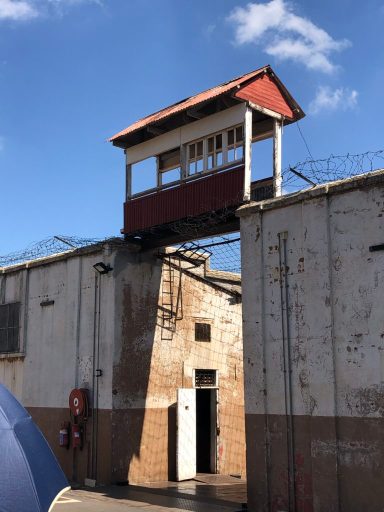
The prison guard tower watches over the yard
The Constitutional Court of South Africa is akin to the Supreme Court of the United States and was created in 1993 during Nelson Mandela’s Presidency and the development of the new constitution of the country. I find it very gratifying to see the chambers of the Constitutional Court placed on the grounds of this most violent place. A vivid acknowledgement to the past and a strong statement to the future.
The Chambers of the Constitutional Congress
Apartheid Museum
“South Africa’s struggle for liberation has been a journey of pain and strife. Freedom brought peace to our land in 1994 after centuries of colonialism and more than 40 years of life under apartheid.” (Quote from the Apartheid Museum website)
Apartheid Musuem (no indoor photos allowed)
What I learned and saw here was the volatile history of this country and how it came to be the fragile place it is today. This museum is one of the best I have ever visited and the hour and forty-five minutes we spent here was not near long enough. I believe you could easily justify an entire day in the cleverly laid-out walk through South Africa’s history.
Both Nelson and Winne Mandela are held in very high regard
On arrival you get your ticket and randomly are given a ticket that says “Whites Only” or “Non-Whites”. Depending on your ticket you enter the museum through different doors – immediately creating a feeling for the visitor that you have stepped back to another era.
The amazing museum is laid out chronologically taking you through the horrors of race classification and how that led to apartheid. You then learn what life was like as a “non-white” during apartheid, the exterminations and executions, the rise of black consciousness leading to the very violent days of 1976 in Soweto. The museum continues through the roots of compromise, the election of President Mandela and the new constitution.
Entering the “Non-Whites” entrance
If you haven’t been to South Africa you may not know about the remarkable Truth and Reconciliation Commission. The museum covers how in 1995 the government created this commission, chaired by Archbishop Desmond Tutu, to promote reconciliation and forgiveness among perpetrators and victims of apartheid. The Commission was charged with three specific tasks: to discover the causes and nature of human rights violations in South Africa between 1960 and 1994; to identify victims with a view to paying reparations; and to allow amnesty to those who fully disclosed their involvement in politically motivated human rights violations.
Inside the “non-whites” entrance
How many places around the world where civil war or civil unrest has left a crack in society should consider something similar to this – so that true healing can actually begin. It’s a true testament to the Mandela leadership era.
The Hector Pieterson Museum
“The Hector Pieterson Memorial and Museum, situated in Orlando West, Soweto, commemorates the role of the country’s students in the struggle against apartheid and in particular the role played by the school children who took part in the Soweto protests of 1976, many of whom were shot by the apartheid police while protesting against the sub-standard of education in black schools in South Africa.” (Quote from Hector Pieterson Memorial and Museum Website)
The photo seen ’round the world, June 16, 1976
What I learned and saw here was an incredibly heartbreaking story of the June 16th, 1976 peaceful protest that took the lives of many young and innocent children including 13 year-old Hector Pieterson. Shot point blank while on the sidewalk.
The extremely graphic photo (shown here) became a symbol for the South African people fighting apartheid and made Hector Pieterson a martyr. Additionally it caused the photographer to flee for his life when the photo went viral around the world. And the young high-school boy carrying the body of Pieterson had to flee South Africa because the police wanted to kill him too. His family never heard from him again. His name was Mbuyisa Makhubo. I write his name here so he is not forgotten. An innocent victim.
Memorial to Hectar Pieterson and all those who were innocent victims
What kind of mad crazy world was this? These were children. Horrifying. This is not a story I knew in depth and I was left feeling so sad. Like the Apartheid Museum this museum does a wonderful job bringing the real people who suffered to the forefront of the story.
Soweto
Soweto (South West Township) was created in the 1930’s when the whites started forcing the black population out of the city of Johannesburg. Soweto became the largest black township in South Africa, where residents were considered temporary and served as the workforce for white Johannesburg. During apartheid, Soweto experienced civil unrest and violence as the slum people began to rise up against the lack of education, sanitation and civil rights. This unrest culminated on June 16 1976 when students staged a peaceful protest against school being taught in Afrikaans instead of the tribal languages. This protest turned violent when the police killed innocent children. The newsreels of that time was seared on the psyche of people around the world and Soweto became known henceforth as the home of the war against apartheid.
Only a few years ago tourists would never come here
Inside one of the “informal” townshps in Soweto
Today, however, Soweto is safe and a visit to Soweto as a tourist is a must. It is however not easy to get around, so having a guide would be advised. Even in Soweto there is a class divide; nicer homes on the outskirts, the “matchbox” houses in the middle and the “informal” villages making up the rest. The informal villages are hammered-together shanty towns, where people who have not been able to get a government issued house live. We toured an informal village and went into a home. It was clean and organized and despite the fact it was made from sheet metal and tarps, you could see the pride the home owner had in her home.
Inside one of the informal Townships in Soweto
Unemployment in Soweto is over 70% and and more than 3 million people live here.
Visiting one of the homes in the informal township
Final Thoughts
For someone from a western culture, and particularly someone who is white, it’s a difficult thing to wrap your head around all that has happened here. Unimaginable to most people. But despite the hardships and the continued race divide we met some very nice people, many working for a better life for themselves and their families. The children we met were very healthy and happy and curious about us. Our time seeing Johannesburg South Africa in one day was educational, enlightening, heartbreaking and hopeful.
The future of South Africa
Slow progress, but will the races ever be on even ground in South Africa? Time will tell, but likely not in my lifetime.
Once again we have stumbled on a country full of surprises. The allure of Oman includes it’s majestic scenery; captivating history; kind and thoughtful people; delicious food; fascinating traditions. Oman is all of this and more…as well as an up and coming tourist destination.
The people of Oman
I’m so grateful to have spent ten days here and hope to return again someday.
History
Oman has a long and fascinating history dating well before the ancient silk and spice roads. Oman is the oldest independent Arab state. At one time the Omani Empire stretched from present day Oman down the East Coast of Africa and included the island of Zanzibar.
Prehistoric findings of the region date back as much as 100,000 years. Over the millenia, Oman has been invaded often by Arab Tribes, Portugal and Britain.
In the 1800’s the country had several sultans ruling over different parts of the territory. In the 1900’s two strongholds remained and tensions caused conflict between the Sultan in Muscat and the Ibadei Imam in Nizwa.
The Sultan of Oman’s Seal
When oil was discovered in 1954 the two factions once again went to war, and the British Army sided with the Sultan and assisted in air raids of the Ibadei region, including the bombing of the Tanuf Castle (see below).
From then until 1970 the Omani people were ruled by Sultan Said bin Taimur who decreed the people could have no luxuries…that included shoes. His medieval and archaic way of thinking bred discord as it was a hard life with no schools, roads, or doctors. Disease was rampant.
“In the 1970 Omani coup d’état, Qaboos bin Said al Said ousted his father, Sa’id bin Taimur, who later died in exile in London. Al Said ruled Oman until his death just last month. As Sultan he confronted insurgency in a country plagued by endemic disease, illiteracy, and poverty. One of the new sultan’s first measures was to abolish many of his father’s harsh restrictions, which had caused thousands of Omanis to leave the country, and to offer amnesty to opponents of the previous régime, many of whom returned to Oman. 1970 also brought the abolition of slavery.
At the Sultan’s Palace built in 1971
Sultan Qaboos also established a modern government structure and launched a major development program to upgrade educational and health facilities, build a modern infrastructure, and develop the country’s natural resources. “(Wikipedia)
Today
The allure of Oman can certainly be credited to the Sultan. The remarkable changes in this country in a mere 50 years is astonishing. We have found excellent infrastructure of highways and roads (but no subway or well connected transit system), sparkling clean public parks and beaches; everyone is educated and speaks English.
With the passing of the beloved Sultan in January, his hand-picked successor (he had no heirs) Haitham bin Tariq became Sultan. It’s not expected much will change immediately.
Wherever we travel, each country has problems. In Myanmar the question of the Royhinga genocide hung heavy over our visit. In China the protests in Hong Kong kept us from our original itinerary. And of course in my own country of the United States, the political upheaval is embarrassing. And Oman too has problems. Cost of oil has dropped and Oman is looking at ways to diversify, including tourism. There are some who feel human rights are neglected and protestors of any kind towards the monarchy are jailed. A clear hierarchy is in place with Omani people serving in government and leadership roles and most service and labor jobs are done by workers who have come from Pakistan, India, Asia and Africa.
Fisherman bring in the catch at Qurum Beach
Oman sits on the Straight of Hormuz at the entrance to the Persian Gulf, only 35 miles from Iran. Oman is focused on territorial stability in a volatile region. As a visitor however you feel very safe and welcome. In fact it feels like a paradise.
The Omani People
We met some really wonderful people during our visit. Although most people keep pretty much to themsleves, it’s not uncommon to have people stop and ask if they can help you find something or ask where you are going or where you are from.
Our hostess for our dinner in her beautiful home
The Muslim men all dress in what is known as the dishdashi and the women are in abaya, usually black but sometimes in other colors. Women wear a hijab. Some women cover their face but most do not. Women actually have a lot of rights in Oman, more than some other Arab countries. They vote, drive and hold professional positions such as doctors, airline pilots and more.
Many people in Oman also dress in “western” clothing, but you will never see shorts or tank tops on locals.
As a visitor I was careful to be respectful of the culture and I did not wear shorts at all during my visit. Long pants and shirts that always covered my shoulders and often my elbows as well. The only time I had to cover my head was when I visited the mosque. (see title photo).
I was a little aghast at some young women we saw from Britain dressed very scantily and I felt it was incredibly disrespectful and as if they were flaunting it. Poor taste indeed.
Spice seller at the Nizwa Souq
Our favorite experience of our visit to Oman was when we went to the home of a distinguished Omani family and had dinner with them in their home. We made this connection through a local business called Zayr whose mission is to connect Omanis with visitors to broaden the understanding of the culture. I am so glad we did this because we really learned a great deal about the daily life of Omanis. The family we visited was a man who is a Omani diplomat, his lovely stay-at-home wife and their five children. We also met a cousin (who works at the US Embassy) and a brother. Another brother is the Omani Ambassador to China. Many of the family members live in a cohabiting way in a large and beautiful house outside of Muscat. We talked about our respective cultures, and how each are so often misrepresented by media accounts of the actions of a few. We ate sitting on the floor in the Omani style and we truly could not have enjoyed this more. We learned about food and traditions such as eating dates in odd numbers, having coffee and dates at every meal and incense burned after the meal to cleanse your palate. It would be my wish that every American could have this experience to understand more about the peaceful and lovely Muslim people.
The lovely family we dined with
Oman, which is about the same size as California, has a population of 4 million, but only 2.5 million of those are Omani. The rest are expats who come to Oman to work, mostly from India, Pakistan, and other surrounding African and Asian nations.
Gulf of Oman
Muscat
The capitol city of Muscat is the most beautiful in Oman. The allure of Oman is found in this utopian city. Restriction on high rise buildings (no more than nine stories) as well as architectural restrictions that only allow Arab style structures with stucco in white and desert colors makes the city very symmetric and alluring. Hundreds of workers can be seen tending greenery in parks, medians and along roads keeping the capital city pristine.
You can also enjoy the beautiful Sultan’s Palace from the outside. The area known as Muttrah was one of our favorites, it includes a beautiful harbor (cruise ships dock here almost daily), a promenade with parks and viewpoints as well as the historic Muttrah Souq.
Muttrah Souq
Outside of Muttrah we also spent one day hiking in the beautiful barren mountains that surround this region. We had an outstanding day hiking up the craggy rocks and returning through the wadi (Arabic for valley or river bed) where we worked our way around babbling brooks and standing ponds back to sea level.
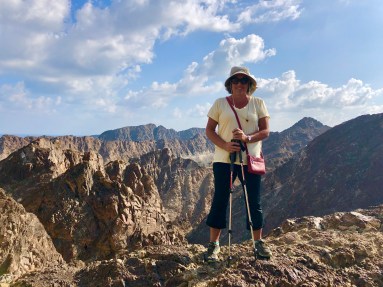
Hiking high above Muttrah
Nizwa and Balha
We took one full day to tour the forts in this region, about a two hour drive southwest from Muscat. Many visitors stay one or two nights in Nizwa but we chose to do it as a day trip from Muscat.
We visited the restored Nizwa Fort, built in the 1600’s and restored in a very high quality way between 1985 and 1995. Today it is one of Oman’s top tourist attractions and we enjoyed it very much. Connecting to the fort is the Nizwa Souq. We hit it on a Saturday and many of the vendors were not open (the weekend is Friday Saturday) but we still enjoyed it and bought some spices and tea and dates.
Nizwa Fort
We also toured the Balha Fort, which was built in the 1100’s. It is currently being restored but you still can walk around it and enjoy it although there is no interpretive information. Hopefully that will be added when the restoration is done.
One of my favorite things we did was crawl around the Tanuf Castle ruins. Nothing has been done to this site and it sits as it has since it was bombed by the British during the insurgence battles between Muscat and Nizwa in the 1950s. I really enjoyed this place and wish the government would add some interpretive information here.
Balha Fort
Many people also go out into the stunning mountains in this region to hike. However we did not rent a 4WD vehicle, and you can’t get very far without one.
Tanuf Castle ruins
Sur and Surrounding
We spent one day driving south and east from Muscat towards the city of Sur.
Our first stop was to just admire the amazing view of the ocean on this drive. The gorgeous turquoise blue of the Gulf of Oman will take your breath away.
Our next stop was at the Bimmah Sinkhole – a super cool hole in the ground that was formed by the collapse of the surface layer of limestone. It is considered a lake but it is slightly salty. Visitors can swim in the crystal clear blue waters and enjoy this area for free.
It is 50m by 70m and 20m deep. There are a few small fish that live in the hole.
Bimmah Sinkhole
Wadi Shab is a very popular hike not far from Sur. Both tourists and locals flock here for the beautiful nature and for a chance to swim in the waterfall cave.
We went to Wadi Shab just after our visit to the Bimmah Sinkhole. However it had rained really hard the day before and we were quit surprised to find mud and silt all over the parking area several inches deep. We were told hiking to the cave was open but expect it to be slippery, muddy and difficult.
With that information we reassessed our plans and decided to give the area a couple days to dry-out and return. Which we did. And I am so glad we did. A forty-five minute hike up the Wadi was difficult but fun. Wading through deep water and clambering over boulders made for quite an adventure. If you want to go to the cave at the top it requires swimming for about 100-yards. We did not do this, but even without seeing the cave, it was one of my favorite things in Oman. I highly recommend it. Hiking in any of Oman’s beautiful Wadi’s should be a highlight of any visit to Oman. Check out this great list to learn how many Wadi options are waiting to be explored.
Wadi Shab
The town of Sur itself wasn’t all that special. We did visit the lighthouse in the old town of Al Ayhar and walked along the ocean boardwalk. We had a wonderful experience having lunch in a tiny little restaurant here. There wasn’t even a menu! The very nice man just brought us lots of lovely food and it all cost only $10.
Wahiba Sands
The Desert
I wanted to see “the desert” and most of the area along the coast of Oman is craggy mountains. Though these mountains are really beautiful, being in the Middle East means camels and sand dunes to me! So from Sur we drove two hours southwest to the Wahiba Sands desert. Without a 4WD you can’t drive into the dunes. There are plenty of drivers available and willing to take you out into the sand. Overnight camel treks are also available. But since we had done both of those in Morocco, Egypt and Namibia, here we decided to just enjoy the view from afar.
Come to Oman
If you are fearful of the Middle East, Oman is the perfect destination. It is welcoming and beautiful and you can learn a lot about the culture of the Middle East and the Muslim people. Don’t fear it – the allure of Oman is as much about the region as it is about the culture…both full of mystery and history just waiting to be discovered.
Muslim people and Omanis in particular are kind and welcoming and want to share their culture and country.
I am so glad we came. Shukran Oman. We feel blessed to know you. Tusahibuk alsalama. Peace be with you.
Have you turned on your tap today and had a quick drink of pure delicious water? Do you spend your days thinking about clean water and the issue of single use plastic?
I can count on both hands how many countries and regions we have visited where we can safely drink the tap water; New Zealand, Japan, most of Western Europe, most of the USA, Canada, Scandinavia.
Even here in Mauritius, a fairly progressive and well run welfare state country, visitors are advised not to drink unfiltered tap water. Even though the locals drink it, a visitor will likely have issues due to microorganisms that could cause diarrhea if you don’t have a tolerance built up.
Water borne illnesses can cause a lot of trouble for travelers, including some serious and potentially fatal diseases. Hepatitis A, Typhoid, Cholera, Giardias are some of the serious diseases that are transferred to humans through water. So thinking about clean water and the issue of single use plastic is something that occupies my mind a great deal.
Unfortunately you should avoid tap water in all of Africa, South America, most of Asia and Eastern Europe, according to the United States Center for Disease Control (CDC).
We always research this issue before arrival and then on arrival reiterate the question of tap water with locals we can trust. Even if the question of water purity is a bit on the fence, we always side with safety first. We have both experienced the results of extreme dehydration and diarrhea and that’s not fun for anybody.
And so what to do? Here in Mauritius like so many other countries, there is but one answer – bottled water.
As a full-time traveler who REALLY wants to make less of an environmental impact and leave as small of a footprint as possible, the issue of water confounds me.
We have yet to purchase and carry a filtration system with us, but I think we will be doing that soon, because we are really conflicted about the single-use plastic. We have two reusable water bottles that we fill frequently with filtered water, but it still calls for us to use plastic bottles way more often than I am comfortable with.
The water filtration unit on the counter left of the sink in Langkawi Malaysia
Here in Mauritius we are purchasing large plastic bottles of water at the grocery store and using it for washing all our fruits and vegetables, making coffee, drinking and brushing our teeth. The good news here on Mauritius is they have a well organized system for plastic bottle recycling. Strategically placed (and loyally used by locals and visitors alike) plastic bottle recycling stations are found around the island. We have seen very little trash here. As a side note they also have a glass bottle deposit system.
We have been really excited to find some countries recently making a huge effort in this area. For instance in Antigua Guatemala the city has instigated a system of clay filtered water stations throughout the city. Free for public use. We also had a clay system filter in our Antigua Airbnb.
Clay filtration system in corner of Antigua Airbnb
Our hotel on Inle Lake (Myanmar Treasure Resort) installed a water refill station for guests while we were staying there. As soon as that was installed we began using it several times a day, even though housekeeping continued to stock our room with single-use plastic water bottles.
Our Airbnb in Cenang Beach Langkawi Malaysia had a wonderful filtration system hooked up to the tap in the kitchen. All water was run through the filtrataion system and we did not need to purchase any bottled water during our month there.
Plastic recycling in Mauritius
In Hua Hin Thailand you could purchase a large five gallon jug of water, then refill it over and over again at a station on the sidewalk near the store for about .25 cents (USD).
Yet in other places beaches are littered with plastic (Thailand, Vietnam) and children play in piles of plastic trash (Burkina Faso, Ethiopia), and locals burn plastic along side the road (Kenya).
Plastic recycling in Mauritius
I’ve been doing a lot of research on water filtration options for travelers, and I think I am leaning towards the Steripen, although there are many versions available. We will be adding this to our collection of things we don’t leave home with soon…and I regret we haven’t done so yet. Here is a blog with great information about this.
Meanwhile, more than half the world doesn’t have good, clean drinking water, while others never think twice about the availability of safe and abundant water to quench our thirst and go about our daily tasks.
It’s one of a copious number of things our planet is lacking for the health and welfare of the people of the world.
Do you use a travel water filter? I’d love to hear your comments about what you like and why.
This website uses cookies to improve your experience. We'll assume you're ok with this, but you can opt-out if you wish.AcceptRejectRead More
Privacy & Cookies Policy
Privacy Overview
This website uses cookies to improve your experience while you navigate through the website. Out of these, the cookies that are categorized as necessary are stored on your browser as they are essential for the working of basic functionalities of the website. We also use third-party cookies that help us analyze and understand how you use this website. These cookies will be stored in your browser only with your consent. You also have the option to opt-out of these cookies. But opting out of some of these cookies may affect your browsing experience.
Necessary cookies are absolutely essential for the website to function properly. This category only includes cookies that ensures basic functionalities and security features of the website. These cookies do not store any personal information.
Any cookies that may not be particularly necessary for the website to function and is used specifically to collect user personal data via analytics, ads, other embedded contents are termed as non-necessary cookies. It is mandatory to procure user consent prior to running these cookies on your website.