Follow:
Topics:
Browsing Tag:

Portugal

    Europe Travel  --  Food & Drink

    Exploring the Cuisine of Sao Miguel Azores Portugal

    Location: Sao Miguel Azores

    We have been on the island of Sao Miguel Azores for just under three weeks and have been loving the food here. Not exactly like mainland Portugal…rather a mix of cultures and flavors from the unique history of the island. Today let me share with you how we are loving Exploring the Cuisine of Sao Miguel Azores Portugal.

    The view from Cha Gorreana Tea Plantation
    The Azores

    The Island of Sao Miguel

    The Azores archipelago is made up of nine islands, with Sao Miguel being the largest. We only visited Sao Miguel, located at latitude 37°42′N and 37°55′N latitude, which puts it on a similar latitude to the southern part of Virginia, southern Missouri, or central/southern California. The volcanic island receives average annual rainfall ranging from 1,000 mm to over 3,200 mm (roughly 39 to 126 inches), which explains the lush, green jungle terrain.

    Northern Coast

    Colonization

    In the 15th and 16th centuries Portuguese settlers began production of wheat to supply garrisons in North Africa and woad (a blue dye plant) which was very profitably exported to Flanders for textile markets. This period also introduced slaves to the island primarily from North and West Africa.

    Orange Wealth

    In the 18th and 19th century wheat was abandoned and oranges became a very profitable crop, with exportation to England. Many British merchants moved to the island and became very wealthy until the orange blight in 1860 wiped out the citrus groves. Many wealthy citrus growers abandoned palaces and left the island.

    Mandarins in the backyard of our Airbnb
    We loved access to these delicious fruits

    New Industries

    The late 1800’s introduced pineapple grown in greenhouses, tea on the wet north coast, as well as tobacco and sugar beets. These can all still be found on the island today.

    Dairy

    But it wasn’t until the 20th Century that cattle and dairy became the cash crop for the islands. Today the island’s beautiful green pastures dotted with black and white cows is a symbol of the award winning cheeses made here. Sao Miguel supplies milk, cheese and butter to mainland Portugal and international markets. Cheese is big business in Sao Miguel.

    Happy Cows come from Sao Miguel
    Lush green fields for Sao Miguel dairy cows

    Let me tell you more about cheese and other delicious foods from our Exploring the Cuisine of Sao Miguel Azores Portugal;

    Cheese

    We ate a lot of cheese during our time on the island. A wide variety of cheese is made across the Azores, from fresh soft cheese to aged hard cheeses. No matter what your taste, you will find a cheese to your liking. Before we began our cheese exploration we signed up for a cheese tasting with Hungry Whales food tour in Ponta Delgada. It was a great way to learn both history and to taste a variety of different cheeses.

    Prince of Cheese offers local cheese and a lot more

    Cheese is available in any grocery store, but there are several cheese shops throughout Ponta Delgado including The King of Cheese located in the Mercado (don’t miss the Mercado) and The Prince of Cheese located on the shopping street near the main square. Both offer tastings, wine and other products. If you want to bring cheese home to the USA you can purchase an aged cheese and they will shrink-wrap it for transport.

    Our cheese tasting with Hungry Whale
    Sao Miguel is famous for the white aged cheddar as well as several other delicious cheeses

    Seafood

    I ate ALOT of seafood while on Sao Miguel. I believe I ordered seafood at all but one restaurant we ate at. Being an island, it’s no surprise the wonderful seafood options available. Octopus and tuna are readily available and delicious. New to me foods included limpets – grilled in the shell, and trigger fish – deep fried. You might know trigger fish as Balistidae or in Hawaii Humuhumunukunukuapuapaa. I had a delicious fresh fish, similar to cod, grilled to perfection, while my husband and our friend Randy enjoyed a whole grilled rockfish. There is shrimp, eel, barracuda, swordfish and more.

    Similar to cod this fresh caught white fish was one of the best things I ate during my time on the island
    Trying grilled limpets for the first time. Similar to mussels or barnacles
    Randy enjoying his whole Rockfish
    Razor clams grilled with garlic and butter. Related to but much smaller than the razor clams we get from the Pacific Coast back home. These were so yummy.

    Sardines and herring are very popular, and we ate small grilled whole sardines at several meals. In addition canned sardines are everywhere and very popular too. They make great gifts to take home and are easy to pack and carry.

    Hot off the grill, these whole sardines are fresh and delicious eaten head and all.
    Comur Sardines are a Sao Miguel favorite
    Fun gifts from the island

    Bakery

    Sao Miguel and the Azores Archipelago have some specialty bakery items that you really should try when you visit. I did not try everything, but I had some favorites The soft and delicious Bolo lêvedo, which looks a little like what we call English Muffins in the USA, is so delicious. Much more tender and delicious than an English Muffin. We bought some and toasted it in the toaster, but locals like it cold with sliced cheese for breakfast.

    Bolo levedo with cheese is a quick and delicious breakfast.
    Toasted with butter for breakfast. Yum.

    Queijadas da Vila are the signature sweet of Vila Franca do Campo on São Miguel. A tiny bit like the famous Portuguese Pastel de Nata, but more cakey than a tart. So good.

    Queijadas da Vila really rich and yummy

    But my favorite is the star shaped Queijadas da Graciosa tarts. These tarts have cheese, pineapple and orange combination that is surprisingly delicious. These also travel well and you can find packed boxes of Queijada da Graciosa ready to tuck in your suitcase to share with family and friends back home.

    Not too sweet – just the way I like a dessert

    Pineapple

    The Azores are not tropical, so how in the world does some of the best pineapple in the world grow here? It’s an interesting story. Below from the website Azores Getaways;

    Inside the greenouse

    Pineapples arrived in the Azores in the mid-19th century, originally as a decorative plant. Wealthy residents grew them in private hothouses with no intention of eating them. The shift came from economic necessity: São Miguel’s orange trade, which had been the island’s primary export, collapsed under competition and disease in the 1800s. Farmers needed a new crop, and pineapple, already proven in the greenhouses, moved from ornament to industry.

    Unlike other crops, glass greenhouses are used for the delicate pineapple operation
    Just a baby. Another 6-8 months until it will be ready.

    The Azores pineapple is grown in whitewashed greenhouses on São Miguel, takes up to three years to produce a single fruit, requires a week of smoke to trigger flowering, and never leaves the island in significant quantity. If you eat it here, you are eating something that exists almost nowhere else in the world.

    Having spent a significant amount of time in the Hawaiian Islands I never would have thought there was better pineapple…but there is. Right here on tiny Sao Miguel.
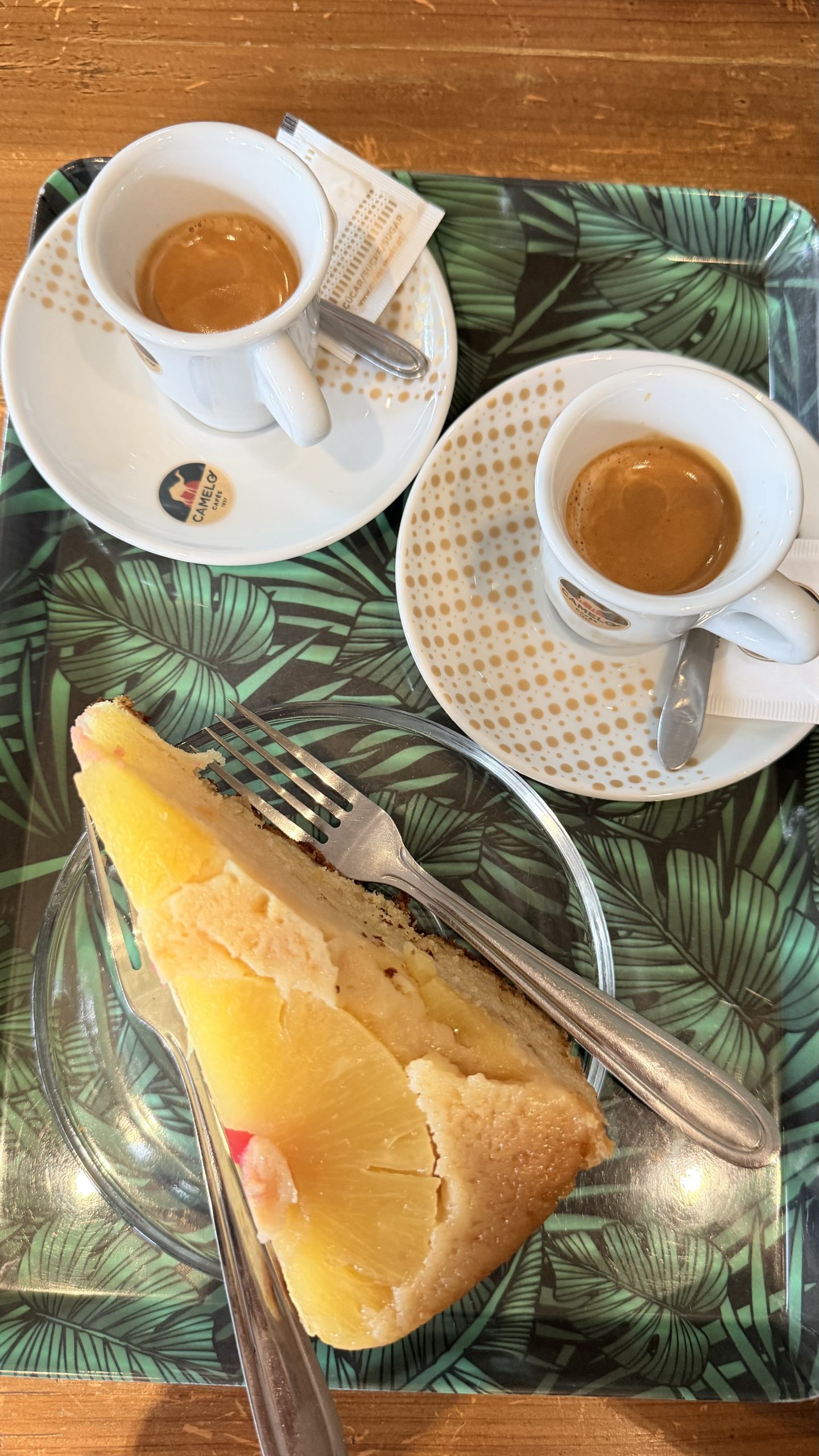
    Afternoon delight – espresso with pineapple upside down cake

    Tea

    What is a tea plantation doing in the middle of this European island? We have visited many tea plantations over the years but never in Europe. Gorreana is Europe’s only tea plantation, operating on Sao Miguel since 1883. Gorreana was started with seeds from Brazil through the Micaelense Agricultural Promotion Society under the leadership of José do Canto. Looking again for diversification after the orange blight, several plantations struggled along in the early years.

    Hiking in the tea fields around Cha Gorreana

    It wasn’t until the Micaelense Agricultural Promotion Society hired the Chinese tea master Lau-a-Pan and his assistant and interpreter, Lau-a-Teng, who brought the ancestral wisdom of tea production. The rest is history. Today tea leaves are harvested between April and October and tea is sold on the island and exported. Visitors are welcome to see the production facility, hike the tea fields and enjoy tea at Cha Gorreana.

    The Tea Ladies hand sorting the stems out of the tea
    Tea is a favorite souvenir to bring home

    Last But Certainly Not Least – Cozido das Furnas

    Cozido das Furnas is considered the signature dish of the island of Sao Miguel. It is a slow-cooked volcanic stew from the parish of Furnas. Furnas itself is a fascinating place to visit (more about this in the next Azores post) and while you are there you must eat Cozido das Furnas.

    In Furnas the stew is cooked buried in the geothermal soil for 5-8 hours. This sign shows the name of each restaurant. Our restaurant is Tony’s

    Chefs layer a mix of meats and root vegetables into a sealed pot, lower it into buracos (holes dug into the geothermally heated volcanic soil near Lagoa das Furnas), and let it simmer for 5 to 7 hours using natural steam and ground heat (roughly 95°C to 100°C). 

    Typically includes beef, pork, chicken, chouriço, morcela (blood sausage), bacon, potatoes, sweet potatoes, yams, carrots, and cabbage. No extra water or stock is added; the steam extracts the juices

    The stew has beef, pork, chicken, two kinds of sausage, kale, cabbage, carrots and two kinds of potatoes and a delicious broth. Very filling and a unique experience.

    When you visit Furnas you can see the mounds that cover the boiling stew below, and if you are lucky you will see the unveiling of the stew as we did. The stew is carted off to the restaurant for lunch or dinner.

    I am so glad we took the time to do this fun and delicious activity while on Sao Miguel.

    Exploring the Cuisine of Sao Miguel Azores Portugal

    We ate really well, and learned a lot too, during our month long visit to the beautiful island of Sao Miguel. I recommend you visit the Mercado da Graca in Ponta Delgada, and any of the other weekly farmers markets scattered around the island. We enjoyed the Mercado Agricola de Santana (Thursday and Saturday) near to our Airbnb.

    Mercada da Graca
    Fall selection of potatoes and squash at Mercada da Graca

    Hungry Whales is also a great resource in Ponta Delgada. We enjoyed a cheese tasting and the next day an exceptional food tour through Ponta Delgada. Delicious and educational.

    The island is home to hundreds of restaurants too. In my next post I’ll share what we found to be our favorites. Thank you for reading my post Exploring the Cuisine of Sao Miguel Azores Portugal. Come back for more Sao Miguel recommendations soon.

    Octopus Salad is one of my favorites
    Fabulous Pineapple
    KIMA Passionfruit soda is a island favorite

    Meanwhile be sure to see last week’s post Egypt – Old, New and Unexpected Too.

    We are always grateful when you pin, share, comment and spend time on our blog. Thank you. Obrigado.

    Europe Travel

    Comparing the Camino Portuguese to the Camino Frances

    My Camino Week One

    Camino de Santiago

    Location: Camino de Santiago

    Here we are.  Walking our second Camino de Santiago.  Why you ask?  Why not?  It just seemed like we should.  Six months ago when we were planning our fall itinerary we were looking at being in Madagascar in October.  Until we looked at the airfare. Yikes.  Madagascar will need to stay on theCamino de Santiago bucket list for a while longer.  So we turned our attention back to one of our favorite countries, Portugal.  And well, here we are.

    Having completed the 486 mile Camino Frances last September, I wasnt sure if the Camino Portuguese would be different.

    It is different. While also being somewhat similar.  One week into the Camino Portuguese, I don’t think I can say I prefer one over the other (yet), because each is special in its own way.  But I have found  myself during week one on the Portuguese Way comparing it to the Frances Way.

    Here are my thoughts so far after one week of walking;

    Distances are Different

    Of course the biggest difference between the two walks is the distance.  When setting out to walk the  most popular Camino Frances many people begin in Saint Jean Pied de Port in France.  This is where we began on September 1, 2017. Forty-one days and 486 miles later we arrived in Santiago, Spain.Camino de Santiago

    On the Camino Portuguese we started in Porto, Portugal on October 21, 2018.  We plan to walk to Santiago and then beyond to  Muxia on the Atlantic Ocean.  This walk will take us about 15 days and will be 217 miles.

    It is a significant difference in distance and days walked – making some of the comparisons here not really fair.

    We are Different

    We are not the same people we were a year ago.  And so this is another major difference.  A year ago we had never tackled anything like walking the Camino de Santiago.  We were a bit frightened, naive and apprehensive.  I think we over trained and over planned and over stressed.  I spent too much time reading what other people thought Camino de Santiagowas best.  Ultimately most of that wasn’t best for me.

    This time we hardly trained, barely planned and did almost zero research.  In fact I stayed away from the Camino Facebook pages (which I found last year too judgmental) and just went with what felt good for us.  We did use the John Brierley books again – a valuable resource for any Camino pilgrim.Camino de Santiago

    We also don’t feel any pressure this time to “succeed”.  We are just enjoying it.  If we don’t finish – no worries.  If it pours down rain and we hop on a train, so be it.  If we get sick or tired and decide to sleep all day – well Buen Camino.  Our Camino, our way.

    Our Bags are Different

    Last year I walked the first 100 miles with a 15 pound pack.  But eventually it was too much for my plantar fasciitis and I began shipping my pack ahead each day.  This year I decided to do it from the very start.  It’s so much better.  I last longer and feel better at the end of the day.  My Camino, my way.Camino de Santiago

    The Terrain is Different

    Over these past six days we have seen quite different terrain than what we enjoyed walking across Spain.  We have spent a lot of time in beautiful wooded areas of eucalyptus, cork and pine trees. We have also spent a lot of time on rocky paths climbing over mountains.  In Portugal in the suburban areas, and even on country roads, we were forced to walk on difficult cobblestones –  both ancient and new.

    Camino de SantiagoSimilar to the Frances we have also spent a lot of time in bucolic farmland with cows, sheep, horses and goats (there is a distinct Camino aroma!).  Most enjoyable is passing miles of vineyards, corn fields, chestnuts, vegetables of all kinds and many fruit and nut trees.  Here along the Portuguese way these things are grown altogether.  In Spain there were more distinctive sections of types of agriculture.

    We left Portugal and entered Spain on day five. Here the path meandered through lovely creek-side Camino de Santiagoshaded paths before we had a major climb with a very steep descent into Redondela.  We are now in Spain’s Galicia region, one of our favorite areas last year on our walk. The mountains bring cooler weather, and marine air from the ocean just 8 miles away.

    On both routes we enjoy the incredible medieval villages, most fully functional and still living, breathing towns – on the Camino Frances it felt like many of these towns were only there because of the Camino – not so much on the Portuguese.   For someone from the USA where old is 200 years, seeing 900 year old villages and 2000 year old Roman bridges and roads still in use is just mind-boggling.

    The Portuguese People are Different

    Perhaps because the Portuguese Way is not as popular as the Frances, or perhaps because the Portuguese people are only beginning to learn how to be Camino entrepreneurs as The Way becomes more popular; for whatever reason there just are not as many businesses catering to pilgrims.

    The accommodations are fewer, the food is definitely not as available and we never encountered anyoneCamino de Santiago just trying to make a buck off of the pilgrims.  Last year in Spain it was a normal sight for someone to be set up on the side of the road selling things to pilgrims.  Restaurants, bars, cafes were abundant.

    But we have found the Portuguese Camino much less developed for pilgrim services.

    The Portuguese people are a bit more shy and quiet.  They nod and say Bom Dia but keep more to themselves than most of the Spanish we encountered on the Frances.

    We expect this to change now that we have arrived in Spain.

    Vandalism is Present

    The first day we entered Spain our guide-book gave us a choice on routes.  We could take the shorter “industrial” route or the slightly longer “scenic” route.  We chose the scenic route.

    Immediately, and for the first time on either the Portuguese or the Frances, we began to see a clear Camino de Santiagoeffort to vandalize signage, misdirect pilgrims and disrupt progress on the “scenic” route.  Beautiful granite markers splattered with paint, arrows blacked out and other arrows trying to get walkers to go another way.  We stayed the course using the map on our phone.

    Our assumption is there are locals not wanting pilgrims to go this way.  I’m sure it’s not all locals, but it was a disappointment to us.  On the Francis we always felt welcome.

    The Pilgrims are Fewer

    The most striking difference to us in week one is how few pilgrims there are.  Last year we found ourselves on the Camino Frances during Camino de Santiagoits busiest September ever.  We had chosen to walk in September because we had read it was a time with fewer pilgrims than in summer but still with good weather.

    Well clearly we were not the only ones who had read this recommendation.  It was very crowded.

    Most days it didn’t matter, but as we got closer to Santiago it was busy and not very peaceful.  Rooms were hard to come by and so we started booking several days and even weeks ahead.Camino de Santiago

    Late October on the Portuguese Way is very quiet.  On our first day we did not see any other pilgrims.  That night at dinner we met a man from Holland.  We have now seen him several times.  We also have often seen a young couple from Italy/Australia and  few others along the way.  But until day five the total number was only about a dozen.

    Camino de SantiagoOn day five we began to encounter more Pilgrims.  We learned many start walking in Valenca, the border between Portugal and Spain.  We met a woman from Seattle (who had heard about us), another woman from Ottawa and another woman from Russia.  We met a group from Australia, a couple from Germany and a couple from Mexico.  We have also seen two young men walking with a dog, several cyclists and a handful of people walking the other direction.  The Portuguese Camino also supports the route to Fatima going south.  Some people walk south from Santiago to Fatima Portugal, a town between Porto and Lisbon where an apparition of the Virgin Mary was considered a miracle and brings pilgrims.Camino de Santiago

    We have enjoyed week one.  We feel healthy and capable.  The forecast for the week ahead has much rain, and we will take it day by day to see how we proceed.  Meanwhile,  I am very happy to be here, experiencing once again the magic of the Camino de Santiago.

    More soon, from the Way of Saint James.  Buen Camino!

    Read about our Camino Frances last year here.


    Please Share Our Blog!

    Camino de Santiago