Note: There will be two blogs today (extraordinary times call for extraordinary measures). I hope you can enjoy both – this is the first.
Such a great story. And a true story too. You will love City of Thieves by David Benioff – his telling of his grandfather’s life during the Nazi’s seige of Leningrad.
Somehow Benioff has grown up not knowing anything about what brought his grandfather and grandmother to America. He knows his grandfather was a soldier…he has heard it whispered all his life that his grandfather killed two Germans. Is it true? Benioff finally decides to sit down with his grandfather and find out. The story he gets is beyond belief.
Poignantly told in the view of Lev Beniov, the sweeping tale is both hilarious and terrifying, heartfelt and thrilling. It is a tale of love, friendship, survival, optimism and the deepest and darkest of wartime crimes.
Benioff is a magical writer and brings the characters so clearly to life through a masterful storytelling talent that will have the reader shivering in the Russian winter snow, feeling the terror of Nazi torture and tasting the warmth of a cup of tea while starving. You will be transported to Russia during World War II. This book review of City of Thieves by David Benioff is a definite thumbs up for a unique WWII story in a current plethora of books on this topic.
*****Five stars for City of Thieves by David Benioff
Note – this will now be a regular update, possibly weekly, in an effort to answer so many questions we are getting and the extreme fluid situation. Love you all.
Cyprus Musings – things are happening quickly now and all indications from where I sit is the world is in this for a very long haul. We are now receiving notices of flight cancellations we have in the future. We are seeing a lot of activity and messages from the US State Department and embassies we have in our itinerary in the months ahead. We received a notice from the embassy of Cyprus that they are trying to secure a flight for US Citizens. I am normally very decisive but now vacillate over this issue because reports here say Cyprus is nearing its peak in virus cases (approaching 200 cases) and I feel safe here. I feel any movement right now, particularly to the USA; on planes; through airports; with other humans; puts us at high risk. But I also feel we might be in Cyprus for months….three, six, more if we don’t take the last plane out. What to do?
Getting home would be a comfort…but if I get sick trying to get there it will create a burden for ourselves and those we love. But if we stay in Cyprus we are useless to my family if they need us. And if we get sick here it could be a financial nightmare (yes we have insurance but it still could be costly).
Mostly I’m no longer worried about the loss of travel money. It’s irrelevant at this point.
When I compare the governments responses between the USA and Cyprus starting when we arrived here 19 days ago I am convinced Cyprus’ quick, decisive and egalitarian approach has saved lives, even though the tight restrictions are causing strife. Nineteen days since we arrived in Cyprus and the USA is still chatting about what to do and state by state mandates are clearly not effective enough for a country the size of the USA. The freedom of assembly will kill us…
Although surreal, watching the world melt down from here is like a giant movie screen. A horror film. With no end in sight and real people at risk. Any one read Station Eleven? It’s happening.
Time to think long term my friends…it’s gonna be a long long time until we have anything resembling the old normalcy. Definitely not Easter. Acceptance of the new normal is the healthiest thing we can do now. It’s okay to grieve. But also prepare. Stay safe. Breathe. Don’t stick your head in the sand…we can be kind and compassionate and try to stay positive while distancing and being ready for a long journey.
I never ever imagined the word pandemic or quarantine becoming a part of my daily vocabulary. And yet it is. Wow. So many surprising things you learn from full-time travel.
A world pandemic is at the top of the list of surprising things you learn from full-time travel. I’ve said it many times, despite all the preparation and planning, reading and studying – there still are so many surprising things you see and learn and experience that you never ever imagined. Pandemic one of many.
Planet in Pain
So today I thought I would share some of these things, since we are still stuck indefinitely here on Cyprus (currently day four of a new three-week total lockdown), it’s a good time to write a blog about the things you don’t realize you will learn from full time travel. The lessons keep coming but here are a few that stand out for me;
How the World Views America
America view
We try to be good ambassadors for our country, but it can be really hard. Because many people have a view of Americans as loud, selfish, gluttonous and most of all ignorant and misogynistic. The view also extends to American media as biased and unreliable.
Where are you from?
So we get this question a lot. Sometimes the question is phrased like this; “Where are you from? Australia? England?”
This always cracks me up because anyone who is a native English speaker is very in tuned to the nuances of those who speak English in the USA vs England, Australia, New Zealand, Ireland etc. But for those whose first language is not English the subtleties are often lost. It’s rare that we get asked if we are from the USA. I believe that is because the countries we are visiting for the most part aren’t often visited by Americans. We are often surprised by how surprised people are to meet someone from the United States.
But the other odd thing when we get asked this question is how the answer goes. We answer “From the United States”, and 95% of the time we get a blank uncomprehending stare. So we rephrase our answer and say “From America.” Ahhh light bulbs come on and faces light up, “Amerikah!”. Despite the fact there is no country called America…much of the world refers to the USA as America.
Metric System
Metric (Canva)
The USA is only one of three countries in the entire WORLD still not using the metric system (Myanmar and Liberia are the other two). I mean honestly people this needs to change. I have no choice but to learn the metric system as we travel and although I don’t have it down perfectly, yet it is an integral part of everyday life from cooking to driving to filling up the car with petrol. We think in Celsius and kilometers, meters and liters. You should give it a try.
Holy Days and Holidays
Semana Santa
In the 110 countries we have now visited we have not visited anywhere that celebrates holy days and holidays by spending the amount of money Americans do on holidays. Most holidays are about family and church with minimal decorating and gift giving. One strange thing…they often leave the Christmas tree up (artificial) until spring.
Airplane Etiquette
Flying
Here is a win for the USA. I have been horrified by how some cultures behave on airplanes – ignoring and harassing flight attendants, barging up the aisle on landing and not letting other people get out into the aisle, as well as other rude behavior. We have found this particularly the case in Asian and African countries. In the USA this would be almost unheard of.
Dogs and Cats
Dogs and Cats
It never occurred to me before beginning our travels that we would witness often horrifying conditions for dogs and cats around the world. I can’t and won’t describe some of the things we have seen…things I try to put out of my mind.
English Speakers
Do you speak English? (Canva)
Before embarking on this full-time travel we had visited many countries in the nearly 40 years we have been married. Some of those countries we found communicating easy and others not so much. But in the past decade most countries have begun teaching English in schools and I can’t think of anywhere we have been in the past four years where we have not been able to speak in English to just about anyone we encounter. English is definitely becoming the world language.
Oh My God
Sunrise over Rabanal
This has become a travel joke for us. Everywhere we go, whether or not the place we are in speaks good English or not, the phrase “Oh my God” is used. It is sometimes the only English words some people know. It is used to express frustration and surprise. I’m not sure if most people even know what they are saying – it’s just a colloquial term used around the world similar to Uff Da or Oi Vey or Gesundheit. Oh my God.
Water
Drinking water
Boy oh boy I sure don’t take clean drinking water for granted anymore. It is to me the biggest problem around the world, and it generates another gigantic problem – what to do with all that single use plastic?
There are some countries and cities making a huge effort. In Antigua Guatemala there are free filtered water stations. In Thailand you can refill giant water jugs for just pennies. Good on ya. I’d love to see this expand.
Germs and Hand Washing
We are all now washing our hands more than ever before. But one thing I have witnessed in most countries is very consistent hand washing already…way more than what I see in public places in the USA. Particularly in Muslim countries but in most other places too people wash not just after using the bathroom but frequently throughout the day, before and after meals and in both public and private places.
Green Africa
Rwanda
Hey guess what? Africa is really, really green. So many Hollywood movies and even NatGeo portray it as a barren brown place – and there are certainly some deserts and dry areas. But most of it is so beautiful and green and big and diverse. You really should go there. Any country…just choose one. They are all great.
Risky Business
Dangerous Hippos
I find myself in situations often while traveling that make me pause…what the heck am I doing? Things like being in a sinking boat in a hippopotamus infested lake, swimming next to the edge of Victoria Falls, hiking on a snowy mountain without clampons, standing 4 meters from a wild Silverback gorilla …crazy stuff. Stuff I wouldn’t be allowed to do in the USA because of much tighter laws and a litigation culture that keeps us away from danger. In most of the world, that is not the case.
Mangos
So many mangoes (Canva)
You might think this is a funny category…and it is. But how did I never know how many kinds of mangos, bananas and so many other kinds of tropical fruit were waiting out there for me? There are 500 kinds of mangos for heavens sake! There are 1000 different kinds of bananas! Have you ever eaten a custard apple? How about a dragon fruit? What about a pomelo or jackfruit or langsat? I’ve been living a sheltered life.
Left or Right
Left side driving (Canva)
Although most countries of the world drive on the right hand side of the road, it still is surprising how many countries drive on the left (including here in Cyprus, a former British colony). Even more surprising is a country like Myanmar, which switched from left-hand driving to right-hand driving in 2015 BUT 90% of the cars still have the steering wheel on the right side. Talk about disconcerting.
Toilet Paper
What can I say?
As toilet paper has become such a valuable commodity in the USA I’ve chuckled about how different Americans view the little white squares compared to the rest of the world. Many cultures don’t use paper…the sprayer attached to the toilet does the job. Many countries you must bring your own paper if you want it, and most countries you aren’t supposed to flush it. Including here on Cyprus where flushing is a no no. Systems are not designed to handle paper, and so it goes into the bin next to the toilet.
It may seem very strange if you haven’t lived somewhere like this but just like anything else you get used to it. I always have TP in my suitcase (and paper towels too) and always have some kind of tissue in my purse.
Have You Learned Anything
Have you learned anything crazy and surprising on your travels? Have you learned anything crazy and surprising from this blog? I could go on and on because there is so much more (cheap medical care, free universities, corrupt governments, government supported community days) that most Americans can’t comprehend.
For me it’s one of the absolutely best things about travel…an eyeopening experience to how the other 96.25% of the world lives. Because get over yourself…the USA is not the center of the universe and we should all try to be more neighborly and interested in our entire planet and the diverse peoples and cultures that make it such a wonderful place.
Don’t give up on travel…we will all hopefully be back traveling again in a few months. Just wash your hands.
We love it when you pin or share our blog. Thank you.
This is a fun, sweet (but totally unrealistic) story of how the Pope and the Dalai Lama decided to take a vacation. I enjoyed this lighthearted story and I think you will too.
As the world has been on lockdown for weeks and months, I came coming back to this story and how it must feel to be someone like Pope Francis or the Dalai Lama whose lives are scheduled to the second and there is no control of your own personal time…ever.
Maybe they feel the need to “get away from it all” from time to time? Well in this fictional story that is exactly what happens. Many of the steps that take place to make this spontaneous get-away happen are ridiculous and could never really happen in real life, but that doesn’t mean it’s not a fun story.
I enjoyed the portrayal of both the Pope and the Dalai, even though for me some of the religious and second-coming references were less believeable. And yet, anyone, whether religious or not will find this story a quick and easy read, with laugh out loud escapades as well as deep perspective moments.
****Four Stars for The Delight of Being Ordinary by Roland Merullo.
As I post this blog we have been self-quarantined on Cyprus for a week. Every day brings a new development. We are currently comfortable and healthy but unsure of how or if our world journey will continue. So for today I thought I would tell you a bit about life on Cyprus under quarantine.
Some Background
Some of you who follow my personal Facebook page might remember this post I made on January 23rd. I said “when people ask me if travel scares me it’s things like this (Corona) that scare me more than terrorism or crime. Luckily we aren’t flying for three more weeks but still its the kind of thing that can explode so quickly…”
That was on January 23rd two months ago and we were in Mauritius. As soon as I read the first story about Wuhan I felt a strong foreboding. But also thought to myself that we had two months in Africa and it would possibly be gone by the time we headed towards Europe.
Wearing a mask on our flight out of Mauritius
But the nagging in the back of my mind made me go to the pharmacy in Mauritius and buy some face masks. The pharmacists asked me if we were going to China? Even he wasn’t thinking about it spreading outside of Asia.
It was late January when the first case was diagnosed in Washington State USA. But the US government did not react.
Carefree in Victoria Falls
Fast Forward Late February
We were carefree in Victoria Falls and in Uganda too as we continued with our planned itinerary. It wasn’t until our arrival in Rwanda on February 27th that we began to see significant changes in airports and hotels (as a matter of fact, Rwanda had the coolest hi-tech system in place for screening). This is when I began taking very strong measures such as washing hands more frequently, not touching railings or elevator buttons and scrubbing things in our room like remote controls and door knobs. I’ve always washed down my airplane space and now we began using a bleach product everywhere we go.
Still touching people in Rwanda
In Kigali Rwanda we bought hand-sanitizer and more face masks, despite now hearing that face masks weren’t helpful. I still wanted to have some.
By this point the virus was spreading in the USA and becoming epidemic in my home state of Washington but Trump continued to deny that it was a legitimate issue or take measures to protect his citizens or the US economy. He was not listening to Advisor’s and making statements like this one – “It’s going to disappear. One day, it’s like a miracle, it will disappear”. As we watched from afar the virus take over entire countries we were flabbergasted at the lack of concern from the US President.
Worries about family back home
People I know back home were split over the issue and not surprisingly along party lines. One faction thinking it was all getting blown out of proportion (and actually blaming Democrats for causing the outbreak to take the focus away from the election) while the other faction was beginning to hoard food, toilet paper and scream that something needed to be done.
Because of the malaria meds we took all through Africa I was suffering with some tummy issues and I was really worried about being flagged on the arrival in Israel since I wasn’t feeling 100%.
Israel
We touched down in Israel on March 4th and absolutely breezed through the airport. We were totally shocked that Israel’s entry was easier than Rwanda or Botswana and Israel seemed to not be doing ANYTHING to check visitors arriving in Tel Aviv. It sounded just like what was happening in the USA. Head in the sand. I was a bit disconcerted.
Unknowingly, this was our final dinner in Israel after only five days
We enjoyed our first few days in Israel but on day four we began hearing that they may close the border to tourists and our planned day trip with a local tour company to Palestine was cancelled when Palestine closed its borders.
We assumed we would be fine since we had arrived in Israel before the border closed, but when we woke up on day six (March 10), regular alerts we receive from the US State Department told us anyone who had arrived in the past week would be quarantined for at least two weeks from date of entry. Spot checks were going to be made and we would need to prove we had a place to stay for a 14-day quarantine. Since our planned itinerary in Israel did not include us staying in one place for 14 days we did not have lodging secured. We made a spur of the moment decision that it would be in our best interest to leave the country while the airport was open and we still could. We made this decision at 8:45 am and were on a flight to Cyprus at 1:45 pm. Never in our nearly four years of travel have we changed our plans so drastically. It was a stressful and heartbreaking decision but in hindsight the right one.
Cyprus
Before leaving Israel we had contacted the Airbnb in Cyprus to see if it might be available early. It was and they welcomed us 15 days early on March 10th. It’s a beautiful spot and perfect for a long stay. We currently have it booked until April 7th.
Cooking Class in Cyprus
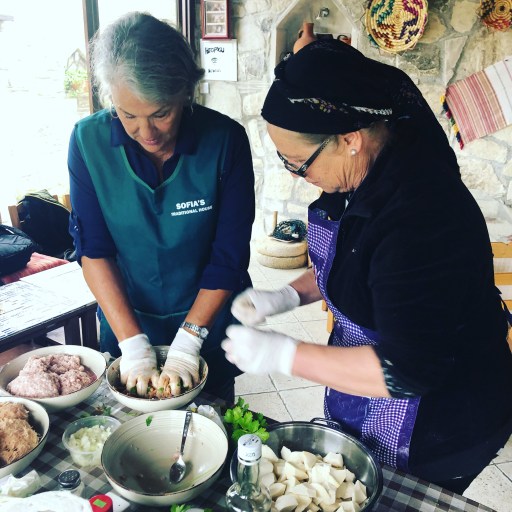
When we arrived in Cyprus ten days ago there were only three cases of Covid-19. We went to the grocery store, the pharmacy and stopped at a sporting goods store to buy sweatshirts. We had coffee in a coffee shop and visited the butcher. Our Airbnb host stopped by with cookies and citrus. Everything seemed normal and no one was panicking. We even did a cooking class and a winery tour and spent one day hiking.
Hiking in Cyprus
But on the evening of March 15th we learned that Cyprus was limiting inbound flights and incoming tourists until April 10th. Schools were closing too and two of the island’s large hotels were closing. The island now had a total of 20 cases, all but one related to incoming visitors. Cyprus is a popular direct flight from London and many British expats live here.
Sunset in Cyprus
This news also included the mandate that any visitor already on the island should self-quarantine for 14 days from the time of entry. So on March 15th we began a self-quarantine. We will stay quarantined until March 24th. For us that means we will still do our morning run, where we have no contact with other people, but spend the rest of the day at our villa.
BUT THEN, on the morning of the 16th it was announced the island was closing all restaurants, hotels, malls, museums, archeology sights until April 30th. Even one hospital was closed for 48 hours for sanitizing. Cases now up to 39.
We now realized that at the end of our 14-day quarantine, we still might not be able to enjoy the the sites of Cyprus because everything will be closed. But, it’s out of our hands.
On March 17th they began turning away people, even residents, arriving on flights unless they had a medical statement of their wellness. And those who were allowed in, are going into a mandatory GOVERNMENT LOCATION quarantine. That’s big…we did not want to be in a government location quarantine.
Today, March 20 th a big announcement. ALL FLIGHTS are to be terminated in and out of Cyprus beginning Sunday. All flights. Wowza. Even flights for Cypriots trying to return home. There is rumor of a possible curfew. Meanwhile today the US government declared a Level 4 Travel Advisory. Better late than never I guess. Hopefully the idiots partying in the Florida beaches aren’t carriers.
Cyprus has very quickly, without a lot of politicizing, created a comprehensive economic assistance plan to help it’s citizens get through this. It’s impressive and quit thorough including such things as unemployment, childcare and elder care. I am impressed with their foresight and lack of political bickering.
As of March 20th, Cyprus now has 81 cases of Covid-19. In the ten days we have been here it’s gone from 3 to 81, an exponential growth.
Grocery stores remain open, but only a dozen people allowed in at a time. We went yesterday and were presented with hand sanitizer and rubber gloves before entering the store.
So every day something new and foreboding.
So Now What?
So now what? I have no idea. Our next flight booked was to Ukraine on April 7th. But even if Cyprus reopens its airport by then, Ukraine’s borders are closed. Beyond that we are supposed to be in Malta in late April and May. As of today Malta’s borders remain open but anyone entering must self-quarantine for 14 days. No doubt that too will change shortly.
Quarantined breakfast in Cyprus
We were planning to attend a wedding in France in late June and then head to the USA for a six month visit. Even if we forego France we are currently unable to get a flight home. We have a lot of money at stake, with little help from airlines or lodgings as far as refunds so far. We did get a refund from Airbnb for our place in Jerusalem, but lost the money for the other hotels and flight changes in Israel. We also got a full refund from our Kiev hotel after we contacted them with a personal email. We are currently waiting to hear from Ukraine airlines.
Of course our health is more important than the money, but we actually might be safer staying put than going to the USA. And we honestly might not be able to get a flight for an indefinite amount of time. We just don’t know.
Our world tour
We feel we can’t make a decision now until the end of March at the earliest, when several countries who closed their borders on March 14th will make a decision as to what’s next. If borders and airports remain closed we may be able to get flight refunds or at least credit. Or we may have to cough up (no pun intended) the money to get back to the USA. Currently a flight from Cyprus through London to the USA will cost us nearly $2000 per person – that is if the Cyprus airport reopens…and if any flights to the USA are running.
My Biggest Fears
My biggest fear is not about coming down with the virus; although we are in our sixties we are healthy and strong. My biggest fear is the economy and how this might effect jobs and lives of people I care about back home. Already my friends and family who own small businesses and restaurants are in dire straits. Even since I began writing this blog several days ago the changing economic impact to the USA seems catastrophic. Frightening.
This is where we are
My biggest fear is that my father (age 87 Alzheimer patient), my mom (age 81) and step-day (age 90 with many medical complications) and my mother-in-law (healthy but age 86) will get the virus. And of course I’m very fearful for my adult sons.
My biggest fear is this thing will go on for months…years? And we may get trapped indefinitely.
I am in no way a “sky is falling” kind of person. I am definitely “look at the bright side” girl. In fact I have been criticized in my life as a “Pollyanna” by people with a less positive outlook.
HOWEVER I am also a realist and see this as a long-term scenario. And that is why the things I listed above scare me.
Meanwhile
Meanwhile we have no choice really but to wait and watch at least until mid April. Hopefully by then we will be armed with enough information to move forward in one way or another. There are few other options. The only silver lining is the weather here in Cyprus is finally beginning to warm up a bit.
I’d love your comments on the blog about your situation wherever you are. I am genuinely concerned for each of you and I am thinking of all of you and sending love and best wishes. God speed.
What a surprise this book was. A book about a book. I loved it.
Set in post-war era where the USA (CIA) is trying to infiltrate the USSR, this book is based on real events and a real plot to bring the classic Russian novel Dr. Zhivago, first out of the USSR to be printed and then back to the people of the USSR to read.
Instead of propaganda, the CIA used Pasternak’s magnum opus against the USSR government. What you say? Crazy right? I had no idea that magnificent book by Pasternak was banned in the USSR and thanks to a net work of primarily female spies, the book was infiltrated into the USSR during the Cold War 1960’s.
The story takes the reader from the height of the Cold War in the Washington DC region to the streets of Moscow and the the Soviet Union prison of Galug. Pasternak and his real life mistress and muse Olga Ivinskaya dedicate their lives to get Dr. Zhivago published. But without the “secretaries” turned spies from the CIA, this classical and epic novel would never have seen print.
The book touches eloquently on so many societal issue of the day from lack of females in prominent roles in offices, to mysogenistic work places. It touches on male dominance of females in the work place as well as the societal norms that women should be home with the children.
I enjoyed this book, learning about the personal life of Pasternak, as well as some of the horribly brutal consequences of going against the government in the Soviet Union. I also thought the author did a great job with the descriptive narrative bringing the reader back to the 1950’s with details about clothing and cars, decor and dining and a variety of other historical detail making the book come to life. This is one book I would love to see as a movie. I’m already thinking about who should play the leads.
⭐️⭐️⭐️⭐️⭐️Five Stars for The Secrets We Kept by Lara Prescott
Like many people, I knew very little about Rwanda, other than the terrible events that happened here in 1994.
It’s interesting to me how many people still believe Rwanda is a dangerous place…26 years after the genocide. The Rwandan genocide, though devastating in the loss of lives (an estimated one-million Tutsis), lasted only 100 days.
Colorful Rwanda fabrics
In the 26 years since, Rwanda has had a renaissance. It hasn’t been easy and it hasn’t been perfect. Following the brutal civil unrest that began on April 7, 1994 and ended three months later, Rwanda struggled to put itself back together.
Government was in disarray (both the President and Prime Minister had been murdered), infrastructure was not in place to handle the hundreds of thousands of children and adults misplaced, orphaned, and suffering both physical and mental trauma. I can only imagine the chaos.
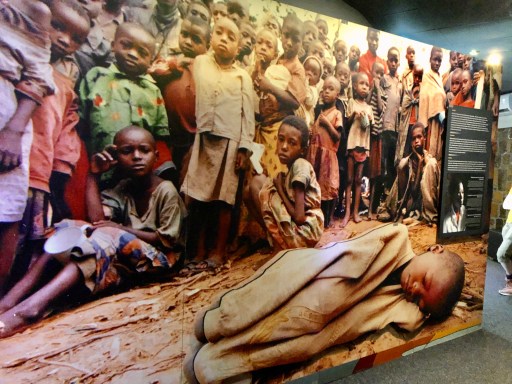
A handful of the genocide victims at the Kigali Genocide Museum
Today Rwanda shows few immediate scars from the horrible events of that spring in 1994, and tourism is on the uptick. It’s inexpensive and friendly and fascinating. Many people come to see the gorillas but we came to just see a wee bit of Rwanda as our final stop in our three-month tour of East Africa.
Genocide
A brief history lesson. It’s complicated but here is a simple synopsis (learn more here);
The Belgians began issuing ID cards to all Rwandans over the age of 10 in 1932-1933. These ID cards, the first Rwandans ever had, showed which tribe they belonged to, Hutu, Tutsi, Twa, or Naturalist. In 1962 Rwanda gained independence but class structure continued to cause conflict. In 1994 President Juvénal Habyarimana was Hutu but he was a moderate Hutu, and class system favoring the Tutsis remained. A faction of Hutu was quietly rising up and this faction was extreme. For months they planned a type of coup.
Belgium Peacekeepers Memorial
On the evening of April 6th, a plane carrying the President and several of his advisors as well as the President of Burundi was shot down on approach to Kigali airport. It is still unknown who shot the plane down with a surface to air missile. Scenarios speculate it was shot down by the Hutu extremists who then blamed the Tutsis in an effort to incite the genocide. Another scenario is that the Rwandan Patriotic Front led by Paul Kagame was responsible in an effort to eliminate the old regime.
Hotel made famous in the movie Hotel Rwanda
On the morning of April 7th the killing began. Hutus began massacring men, women and children, using the tribal identity cards to choose who lived and who died. Hutus also killed moderate Hutus and forced moderate Hutus to murder their own Tutsi neighbors or they would be killed. Belgium had a peacekeepers force in place, who tried to protect the Prime Minister, but all 12 of the Belgian peacekeepers were killed along with the Prime Minister and her husband. The United Nations was totally unprepared for the magnitude of the killing spree and no other country came forward to assist.
Meanwhile one million people were killed before the insurgent RFP army led by Tutsi Paul Kagame (who later went on to become President in 2000) took control of the bloody war.
Today in Kigali
Today President Kagame is leading the country forward with a focus on technology and tourism as well as other industries. There is construction everywhere, even though the majority of the Rwandan population remains agrarian.
Kigali Genocide Museum
A visit to Kigali is a must to see the Kigali Genocide Memorial and the Belgian Peacekeepers Memorial. Both are worth a visit and give a truthful albeit painful chronology of what happened to the beautiful people of Rwanda during the genocide. You can also stop by the Hotel des Mille Collines, also known as Hotel Rwanda.
There is another museum, newly opened that we did not visit called the Campaign Against Genocide. This museum explains how the insurgents took the country back. We are sorry we did not get to see this one.
Lake Kivu
Seeing gorillas (and chimpanzees) is the biggest tourist draw in Rwanda, but since we had already done that we chose to spend four days on Lake Kivu, about a four hour drive from Kigali. The town of Gisenyi sits right on the border of the Democratic Republic of Congo. Congo is a country currently in turmoil and we had no interest going there. But the people of Gisenyi and its Congolese sister town of Gomo pass back and forth over the border with ease.
Beautiful Lake Kivu Gicenyi Rwanda
During our short visit we enjoyed a lovely boat tour of the lake to see the many islands in this gigantic lake ( maximum depth of 475 m (1,558 ft) and is 90km long (56 miles) and 50km wide (31 miles)) as well as to see the fishing industry, hot springs, busy market place and to get a good look at the DRC from the water side. Lake Kivu has methane gas from surrounding volcanoes that Rwanda is attempting to harness for electricity.
Touring Lake Kivu and a bridal party in the background
On our second day we had a wonderful 18 km day hike (one way with a return by boat) with a guide along the Congo Nile Trail. The trail goes 227 km along the east side of Lake Kivu, which marks the divide between the Congo drainage basin and the Nile drainage basin. This is probably our favorite thing we did in Rwanda. It’s a tough hike, even just doing the 18 km (you can walk the entire 227 km) but it provides beautiful views of the lake, lots of bird watching and opportunities to learn about agriculture of Rwanda (particularly the coffee). But our favorite thing was all the kids we met along the route, most going to and from school from their rural mountain villages. We passed a primary school and all the kids were out in the courtyard and they ran out into the dusty dirt road to hug us. They call us muzunga (pale skin) and are genuinely happy to see us.
One of hundreds of kids we saw on the Congo Nile Trail
Both of our tours in the Lake Kivu region we did with Ames Tours. I highly recommend them.
The flower, green berry and red berry of the healthy coffee plant Rwanda
Umuganda
One of the most astonishing things we learned about the people of Rwanda is regarding the monthly celebration of Umuganda, which roughly translates to community day.
The hard working people of Rwanda
On the last Saturday of EVERY month, from 8am – 11am in the morning, all adult citizens are required to participate in Umuganda. We had not been made aware of Umuganda, and stepped outside at 9am on Saturday morning to an absolute ghost town – no cars, no taxis, no motos, no people, no shops open…not even a dog or cat. It was eerie. We then learned about Umuganda. Police patrol the main streets because no one is supposed to be driving. Everyone should be in their village and neighborhood helping each other.
We met so many wonderful kids, ready to bring Rwanda forward in peace
Community projects are undertaken through out the entire country on Umuganda. It might be helping someone whose home is in need of repair. It might be clearing a field or repairing a bridge. It might be just families working together to build or harvest. It might be adding a room onto the school or building an entire road. It’s an age-old tradition in this country, fully supported by the people, mandated by the government and a bit shocking for an unprepared visitor.
In the 110 countries I have been to, I’ve never seen anything like it. I can’t begin to imagine something like this in my home country of the United States. Selfless, productive, loving and revered. Wow.
Final Thoughts
Rwanda is tiny, about the size of the state of Maryland. It has endured a great deal. Our short visit to Rwanda was very eye-opening. We met some wonderfully kind and proud people. The population has few elderly, both due to the genocide and the difficult agrarian lifestyle. But I am convinced I have never met a harder working population than Rwanda. Everyone is working – man, woman, and child. The Tutsi are in charge of the government now, and big efforts continue for all people whether Tutsi or Hutu to live together as Rwandans. Rwandan proud. Rebirth of Rwanda, a renaissance story.
The youth of Rwanda
We wish them continued success.
We love it when you pin or share our blog. Thank you.
This website uses cookies to improve your experience. We'll assume you're ok with this, but you can opt-out if you wish.AcceptRejectRead More
Privacy & Cookies Policy
Privacy Overview
This website uses cookies to improve your experience while you navigate through the website. Out of these, the cookies that are categorized as necessary are stored on your browser as they are essential for the working of basic functionalities of the website. We also use third-party cookies that help us analyze and understand how you use this website. These cookies will be stored in your browser only with your consent. You also have the option to opt-out of these cookies. But opting out of some of these cookies may affect your browsing experience.
Necessary cookies are absolutely essential for the website to function properly. This category only includes cookies that ensures basic functionalities and security features of the website. These cookies do not store any personal information.
Any cookies that may not be particularly necessary for the website to function and is used specifically to collect user personal data via analytics, ads, other embedded contents are termed as non-necessary cookies. It is mandatory to procure user consent prior to running these cookies on your website.